Jim Gates: Supersymmetry, String Theory and Proving Einstein Right
Core Takeaways
Jim Gates argues that sending humans to Mars by 2030 is at least 1,000 times harder than the moon landing due to funding and biological challenges.
Why it matters
The immense difficulty of Mars travel highlights the need for revolutionary breakthroughs in technology and funding to achieve interplanetary exploration.
Supersymmetry suggests every known particle has a superpartner, filling gaps in particle symmetry diagrams.
▶ 1:23:45
Why it matters
Supersymmetry could solve existing gaps in particle physics and lead to new discoveries if experimentally validated.
String theory lacks a unifying paradigm but offers mathematical insights like weak-strong duality and holography.
▶ 2:45:30
Why it matters
String theory's mathematical frameworks have advanced quantum mechanics understanding, even without experimental confirmation.
Error-correcting codes, crucial in digital communication, are also found in genetic structures, hinting at their fundamental role in physics.
▶ 3:15:00
Why it matters
The presence of error-correcting codes in genetics suggests a deep connection between biological and physical systems, potentially guiding future physics research.
Ask this episode Deep
A preview of how Deep chat answers, grounded in this episode with citations and timestamps:
Cite this episode
For papers, blog posts, anywhere.
Related episodes
Where to go next from this conversation.
More on these ideas
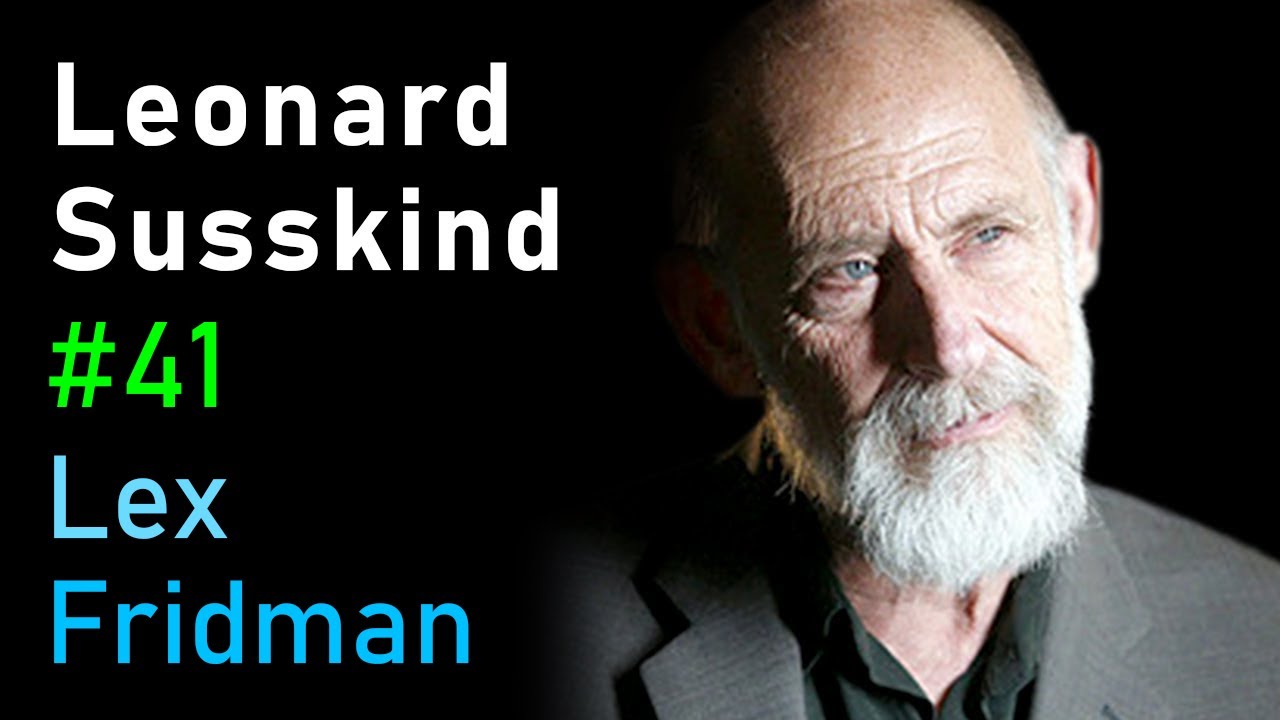 Leonard Susskind: Quantum Mechanics, String Theory and Black Holes
Shares string theory, consciousness
57m
Leonard Susskind: Quantum Mechanics, String Theory and Black Holes
Shares string theory, consciousness
57m
 Brian Greene: Quantum Gravity, The Big Bang, Aliens, Death, and Meaning
Shares string theory, consciousness
1h 45m
Brian Greene: Quantum Gravity, The Big Bang, Aliens, Death, and Meaning
Shares string theory, consciousness
1h 45m
 Roger Penrose: Physics of Consciousness and the Infinite Universe
Shares consciousness
1h 27m
Roger Penrose: Physics of Consciousness and the Infinite Universe
Shares consciousness
1h 27m
 Cumrun Vafa: String Theory
Shares supersymmetry, string theory
2h 13m
Cumrun Vafa: String Theory
Shares supersymmetry, string theory
2h 13m
AI-generated summary · last refreshed 2026-06-08 17:20:40 · how we make these
Quotes are matched verbatim against the source transcript; references are checked to resolve to real URLs. Even so, AI can misread structure or attribute claims imperfectly. If you spot an error, please let us know.