FW
Guest dossier
Frank Wilczek
physicistprofessortheoretical physicistuniversity teacher
Frank Anthony Wilczek is an American theoretical physicist. He shared the 2004 Nobel Prize in Physics with David Gross and H. David Politzer "for the discovery of asymptotic freedom in the theory of the strong interaction".
Across 1 conversation, Frank Wilczek ranges across asymptotic freedom, gravitational waves, complementarity. Frank Wilczek describes asymptotic freedom as quarks behaving like free particles at high energies, a key feature of quantum chromodynamics. Axions, hypothetical particles, could solve the strong CP problem and account for dark matter by filling the universe with energy from residual oscillations.
Synthesized by TLexDR from 1 conversation. AI-generated. Report an inaccuracy
The idea map
Frank's intellectual territory
Click a star to read the quotes and jump into the episode.
For the specialist
previewAsymptotic freedom, a counterintuitive concept, reveals that quarks interact weakly at close proximity, altering traditional force interaction models.
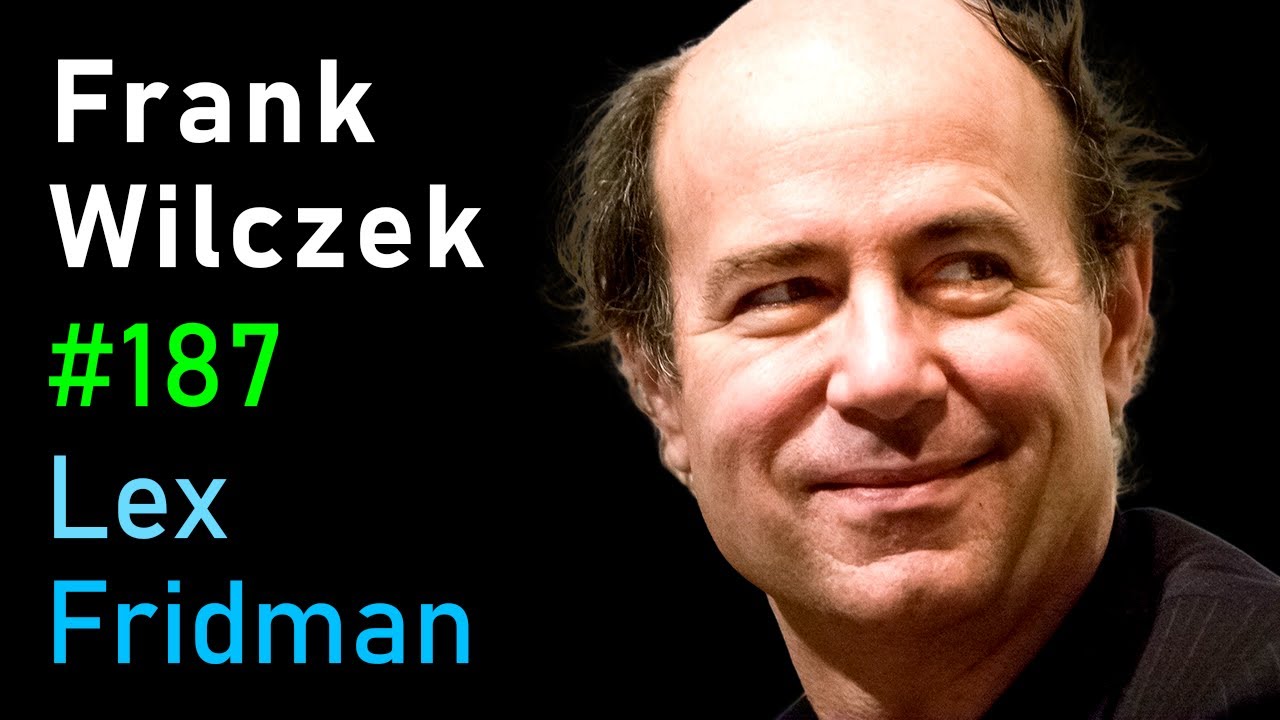
#187Frank Wilczek: Physics of Quarks, Dark Matter, Complexity, Life & Aliens
Axions, if detected, could revolutionize our understanding of dark matter by acting as a field rather than a constant, influencing cosmic evolution.
#187Frank Wilczek: Physics of Quarks, Dark Matter, Complexity, Life & Aliens
The emergence of intelligent life being rare suggests a unique evolutionary pathway on Earth, impacting astrobiological studies.
#187Frank Wilczek: Physics of Quarks, Dark Matter, Complexity, Life & Aliens
The appearance
Every conversation, in order
Reading list
What they pointed you toward
books
papers
Every idea, by region