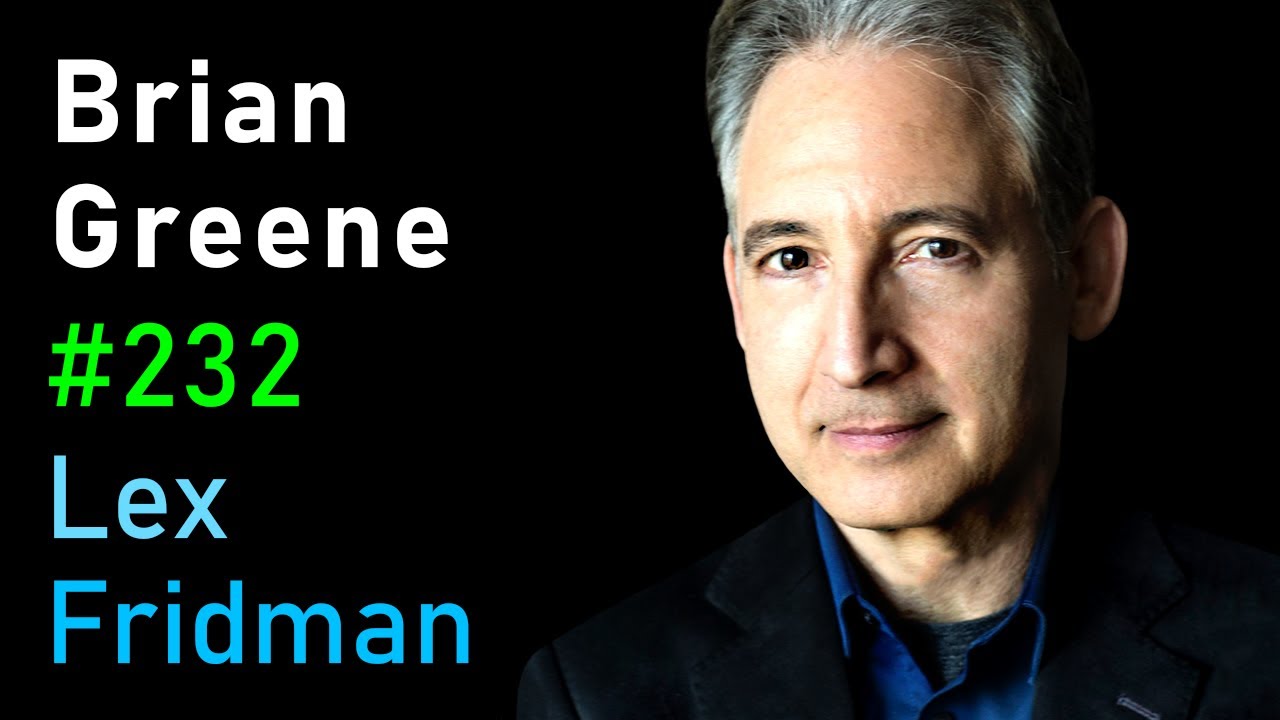
New Lex Fridman Insight: Brian Greene: Quantum Gravity, The Big Bang, Aliens, Death, and Meaning
Sent June 11, 2026
Key Insights
- Brian Greene sees consciousness as a continuum, complicating its precise definition and emergence in living beings.
- Inflationary cosmology, dominant since the 1980s, explains the Big Bang through repulsive gravity from early universe energy.
- Dark energy's peculiar value challenges current physics, prompting alternative theories like cyclic cosmologies.
- String theory, integrating quantum mechanics and relativity, faces experimental validation challenges, leading Greene to suggest calling it a hypothesis.
- Greene argues that the traditional notion of free will doesn't hold under physical laws, as all actions are governed by these laws.
How the conversation moved
The host opened the discussion by framing the episode around fundamental questions of existence and the universe, setting the stage for Brian Greene to explore concepts like consciousness, entropy, and meaning. Greene began by discussing the second law of thermodynamics, explaining how entropy leads to disorder over time, and how this principle affects the complexity of life and consciousness. He proposed that consciousness exists on a continuum, challenging binary definitions and complicating its precise emergence in living beings.
Greene then shifted to cosmological theories, focusing on inflationary cosmology as the dominant explanation for the Big Bang. He explained how this theory relies on repulsive gravity from a specific type of energy in the early universe. Greene also touched on alternative theories like cyclic cosmologies, which offer different perspectives on dark energy and the universe's expansion. He noted the peculiar value of dark energy and how it challenges existing physics, prompting exploration of new models.
Despite the depth of these discussions, there was a notable lack of pushback or tension from the host, leaving Greene's views largely unchallenged. This absence of counter-arguments meant that the conversation flowed smoothly from one complex topic to another without much debate or contradiction. However, Greene himself critiqued some theories, such as Roger Penrose's conformal cyclic cosmology, suggesting it felt constructed to find solutions rather than naturally emerging from data.
The conversation concluded with Greene addressing the challenges faced by string theory, particularly its lack of empirical validation. He suggested that string theory should be referred to as a hypothesis, highlighting the gap between theoretical predictions and experimental evidence. Greene also explored philosophical implications of physical laws on concepts like free will, arguing that traditional notions of autonomy do not hold under these laws. The discussion ended with an open question about the future of these theories and their potential to reshape our understanding of the universe.
Surprising moments
In-depth
Consciousness and Meaning
- Consciousness is a continuum, complicating its definition.
- Entropy drives disorder, affecting life's complexity.
- Individuals create their own meaning and purpose.
Cosmology and the Big Bang
- Inflationary cosmology explains the Big Bang with repulsive gravity.
- Cyclic cosmologies offer alternatives to inflationary theory.
- Mathematical singularities challenge definitive cosmological statements.
String Theory and Experimental Physics
- String theory integrates relativity and quantum mechanics.
- Lack of empirical validation leads Greene to suggest calling it a hypothesis.
- The Large Hadron Collider could potentially detect extra dimensions.
Still open
- Greene questioned whether string theory will ever achieve empirical validation, leaving its status as a theory or hypothesis open.
References & Resources
- Until the End of Time, Mind, Matter, and Our Search for Meaning in an Evolving Universe by Brian Greene — Search
- What is Life? by Erwin Schrödinger — Search
- The Inflationary Universe by Alan Guth — Search
- The Grand Design by Stephen Hawking — Search
- Conformal Cyclic Cosmology by Roger Penrose — Search
- The Drake Equation by Frank Drake — Search
- The Denial of Death by Ernest Becker — Search
- The Elegant Universe by Brian Greene — Search
- The Fabric of the Cosmos by Brian Greene — Search
- The Higgs Particle by Peter Higgs — Search
- General Theory of Relativity by Albert Einstein — Search