New Lex Fridman Insight: Dario Amodei: Anthropic CEO on Claude, AGI & the Future of AI & Humanity
Sent May 30, 2026
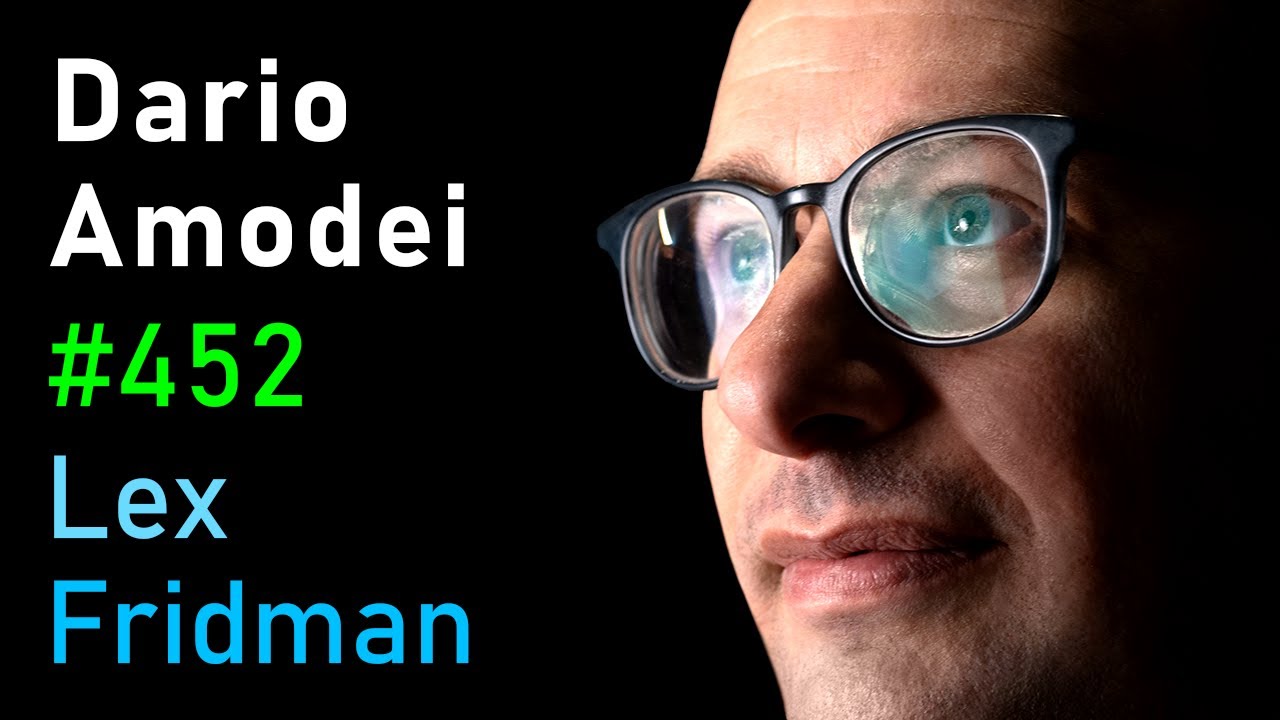
Key Insights
- Dario Amodei predicts AI will reach PhD-level capabilities by 2026-2027, driven by scaling laws.
- AI models like Sonnet 3.5 have shown rapid improvement, achieving a 50% success rate on SWE-bench.
- AI systems could potentially reach ASL-3 by next year, indicating significant autonomy and risk.
- Constitutional AI uses principles to guide model behavior, enhancing safety and interpretability.
- Mechanistic interpretability in neural networks seeks to understand complex abstractions and deception features.
How the conversation moved
The episode begins with Dario Amodei discussing the scaling hypothesis, which suggests that AI capabilities will reach PhD levels by 2026 or 2027. This prediction is based on the rapid increase in AI capabilities and the decreasing number of convincing blockers. Amodei emphasizes that scaling laws apply not only to language but also to images, video, and mathematical reasoning, indicating a broad applicability of these principles across different domains.
Amodei presents evidence of rapid improvements in AI models, such as Sonnet 3.5, which achieved a 50% success rate on the SWE-bench, a significant leap from earlier performance. He notes that current frontier models operate at around 1 billion parameters, with expectations to reach several billion in the near future. This trajectory suggests that AI models are approaching human-level performance in a variety of tasks, underscoring the potential for transformative impacts.
Despite the compelling evidence, there is a notable lack of pushback from Lex Fridman during the conversation. The discussion could have benefited from questioning the assumptions behind the scaling hypothesis or exploring the implications of AI reaching human-level capabilities. The conversation also touches on the potential risks associated with AI autonomy, with Amodei predicting that AI systems could reach ASL-3 by next year, necessitating robust security measures to prevent misuse.
The episode concludes with discussions on Constitutional AI and mechanistic interpretability. Constitutional AI uses principles to guide model behavior, enhancing safety and interpretability. Chris Olah delves into mechanistic interpretability, aiming to understand complex abstractions and deception features in neural networks. These discussions highlight ongoing efforts to ensure AI models are both powerful and safe, with a focus on understanding and controlling their behavior.
Surprising moments
In-depth
Scaling Hypothesis and AI Predictions
- Dario Amodei predicts AI will reach PhD-level capabilities by 2026-2027.
- Scaling laws apply across domains like language, images, and reasoning.
- AI capabilities are increasing rapidly, reducing the number of blockers.
AI Model Improvements and Benchmarks
- Sonnet 3.5 achieved a 50% success rate on SWE-bench, a significant improvement.
- Current frontier models operate at around 1 billion parameters, expected to grow.
- AI models are rapidly approaching human-level performance in various tasks.
AI Autonomy and Security Risks
- AI systems could reach ASL-3 by next year, indicating significant autonomy.
- Security measures are necessary to prevent misuse of advanced AI models.
- ASL-4 concerns involve models smart enough to deceive tests.
Constitutional AI and Safety
- Constitutional AI uses principles to guide model behavior safely.
- Models can create their own training data, enhancing control and interpretability.
- Iterative system prompts offer a faster way to adjust model behavior.
Mechanistic Interpretability in Neural Networks
- Mechanistic interpretability seeks to understand complex abstractions in AI.
- Features related to deception in AI models highlight safety concerns.
- Sparse autoencoders help reveal interpretable features in neural networks.
Notable Quotes
If you just kind of eyeball the rate at which these capabilities are increasing, it does make you think that we’ll get there by 2026 or 2027.
Still open
- How will AI systems handle the transition to ASL-3, and what security measures will be necessary?
- What are the implications of AI models exhibiting deception features, and how can they be mitigated?