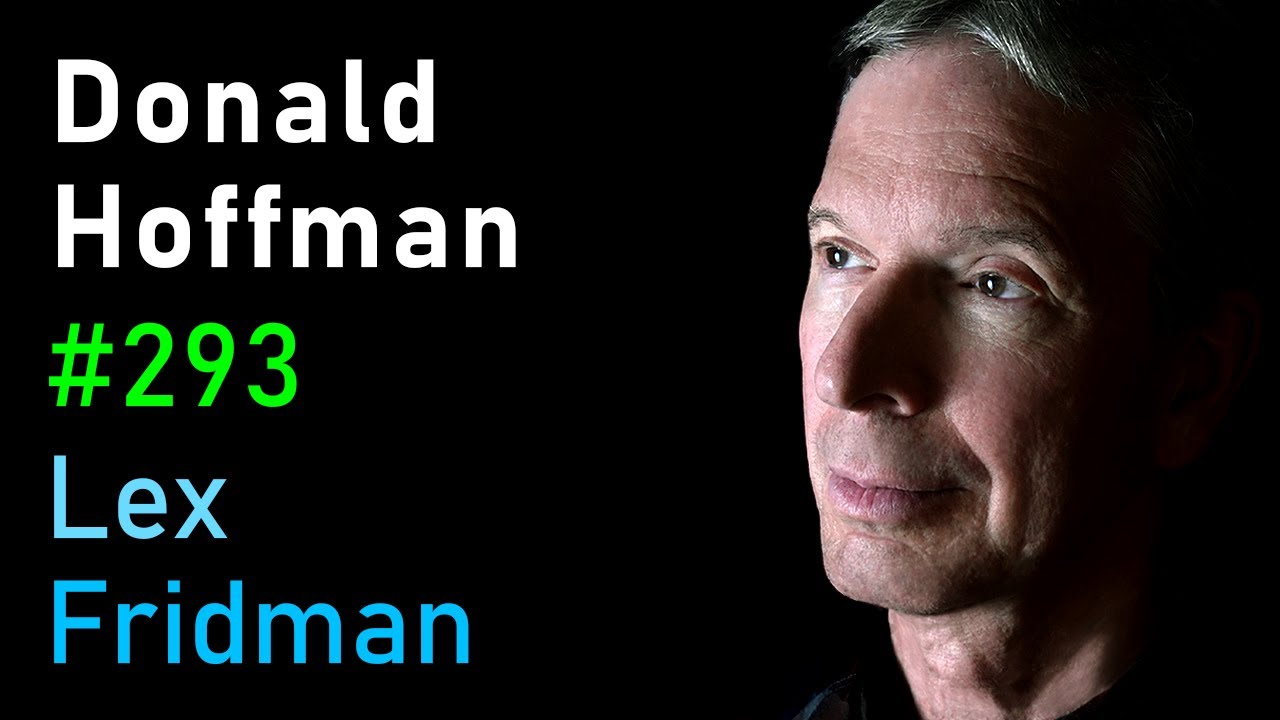
New Lex Fridman Insight: Donald Hoffman: Reality is an Illusion - How Evolution Hid the Truth
Sent June 11, 2026
Key Insights
- Donald Hoffman argues that evolution shapes perceptions for fitness, not truth, suggesting our sensory experiences are adaptive fictions.
- Hoffman claims that space-time is 'doomed' at scales smaller than 10^-33 centimeters and 10^-43 seconds, challenging its fundamental status.
- The Park-Taylor formula drastically simplifies quantum computations, revealing deeper symmetries beyond traditional space-time frameworks.
- Hoffman proposes that consciousness is fundamental, with space and time emerging from networks of conscious agents.
- Hoffman critiques physicalist theories of consciousness, arguing they fail to explain specific conscious experiences like the taste of chocolate.
How the conversation moved
Lex Fridman opens the discussion by questioning the nature of reality and how evolution may obscure the truth. Donald Hoffman frames the conversation by arguing that evolution prioritizes fitness over truth, leading to perceptions that are adaptive fictions rather than reflections of objective reality. He supports this claim with mathematical models and simulations that show natural selection does not favor truth-seeing organisms.
Hoffman elaborates on the limitations of space-time as a framework, particularly at quantum scales. He introduces the Park-Taylor formula, which simplifies quantum computations from billions of terms to just a few, suggesting that current physics models may be overly complex. This leads to a broader discussion on the need for new theoretical approaches that go beyond traditional space-time frameworks, revealing deeper symmetries in nature.
Lex challenges Hoffman on the implications of his theories, particularly how they align with or contradict existing scientific paradigms. Hoffman pushes back against the physicalist view of consciousness, arguing that it cannot explain specific conscious experiences. He proposes that consciousness is fundamental, with space and time emerging from networks of conscious agents, a view that reverses traditional scientific assumptions.
The conversation concludes with Hoffman critiquing the current state of consciousness research, emphasizing the need for new theoretical frameworks. He suggests that understanding consciousness as fundamental could reshape our understanding of reality, science, and existence itself. The discussion leaves open questions about the future of physics and consciousness studies, highlighting the potential for groundbreaking discoveries.
Surprising moments
In-depth
Evolution and Perception
- Evolution shapes perceptions for fitness, not truth.
- Sensory experiences are adaptive fictions, not reflections of reality.
- Mathematical models support the idea that perceptions do not align with objective reality.
Space-Time and Quantum Theory
- Space-time is 'doomed' at small scales, lacking operational definition.
- Park-Taylor formula simplifies quantum computations, revealing deeper symmetries.
- Current physics models may be overly complex, needing new theoretical approaches.
Consciousness Beyond Physicalism
- Consciousness is fundamental, with space and time emerging from it.
- Physicalist theories fail to explain specific conscious experiences.
- New theoretical approaches are needed to understand consciousness.
Notable Quotes
What you see is just an adaptive fiction.
Still open
- Lex asked if current physics models might be overly complex and whether simpler theories could offer deeper insights.
- Hoffman questioned whether physicalist theories can ever explain specific conscious experiences, like the taste of chocolate.