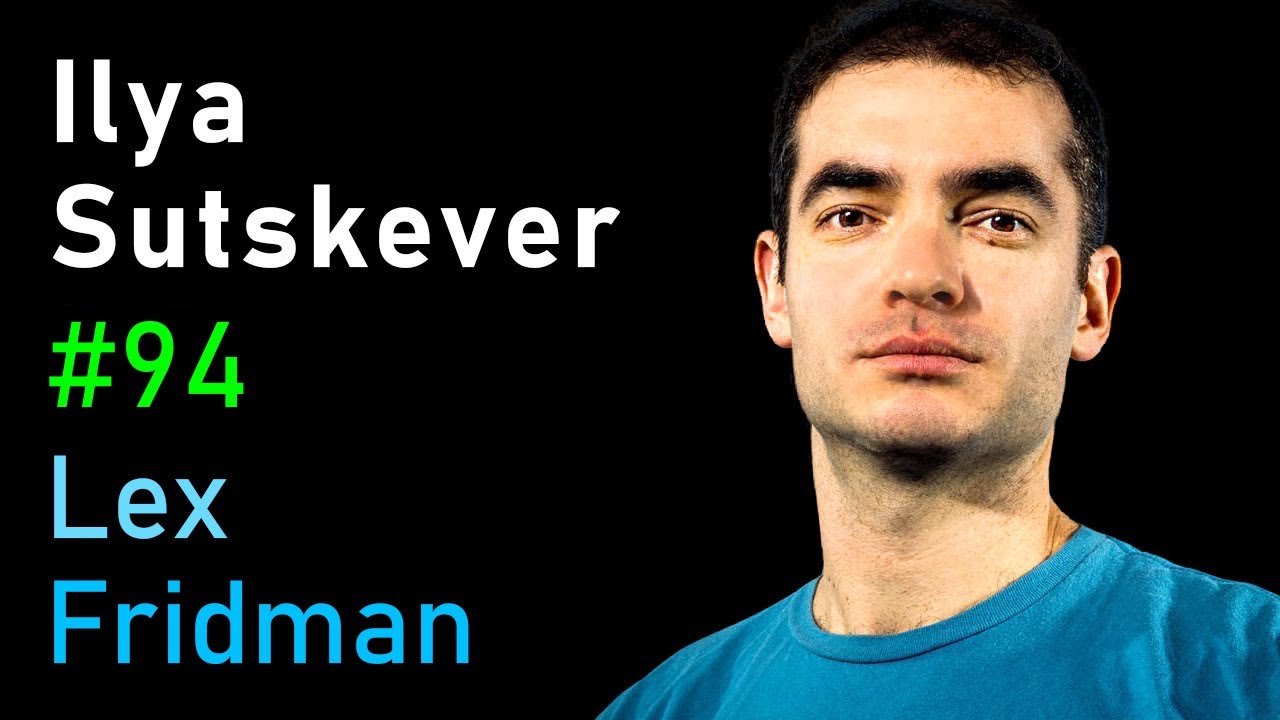
New Lex Fridman Insight: Ilya Sutskever: Deep Learning
Sent June 11, 2026
Key Insights
- Ilya Sutskever co-authored the AlexNet paper, a pivotal moment in deep learning's rise.
- Transformers have replaced RNNs due to their efficiency and scalability in deep learning tasks.
- OpenAI's staged release of GPT-2 was a strategy to mitigate potential misuse of powerful AI models.
- Double descent is a phenomenon where model performance improves, worsens, then improves again as model size increases.
- Sutskever envisions AGI systems as democratic entities, potentially serving as CEOs of cities or countries.
How the conversation moved
The host opened the discussion by framing the evolution of deep learning as a series of pivotal breakthroughs, inviting Ilya Sutskever to reflect on his role in these developments. Sutskever highlighted the creation of AlexNet and the Hessian free optimizer as key moments that demonstrated the potential of deep neural networks. He drew parallels between neural network performance and the human brain, suggesting that deep learning models can mimic brain processing speeds under certain conditions.
Sutskever's main argument centered on the transformative impact of transformers over recurrent neural networks, emphasizing their efficiency and scalability. He provided concrete examples, such as GPT-2's training on 40 billion tokens, to illustrate the capabilities of transformer models. The conversation also touched on the role of skepticism in the field, which was overcome by hard benchmarks that proved deep learning's effectiveness beyond doubt.
Despite the compelling narrative, there was little pushback from the host on Sutskever's claims, particularly regarding the potential for AGI systems to act as democratic entities. The lack of challenge left open questions about the feasibility and ethical implications of such a vision. The conversation also skirted around the complexities of AI ethics, focusing instead on the technical achievements and future possibilities.
The discussion concluded with Sutskever envisioning a future where AGI systems could serve as CEOs, representing cities or countries in a democratic process. This ambitious vision underscored the potential societal impact of AGI but left unresolved questions about governance and control. The conversation pivoted towards the philosophical implications of AGI, with Sutskever expressing a willingness to relinquish control over these systems to prevent power concentration.
Surprising moments
In-depth
Deep Learning Milestones
- Ilya Sutskever co-authored the AlexNet paper, marking a pivotal moment in AI.
- The Hessian free optimizer enabled training deeper networks, a breakthrough in 2010.
- GANs lack a clear cost function, likened to biological evolution without a definitive goal.
Transformers vs. RNNs
- Transformers have replaced RNNs due to their efficiency and scalability.
- GPT-2, a transformer model, was trained on 40 billion tokens, showcasing its capability.
AI Ethics and Deployment
- OpenAI's staged release of GPT-2 mitigated potential misuse.
- AI's maturity is marked by ethical considerations in deployment.
Double Descent in Neural Networks
- Double descent describes performance fluctuations as model size increases.
- Early stopping can mitigate double descent by preventing overfitting.
AGI and Societal Impact
- Sutskever envisions AGI as democratic entities, potentially serving as CEOs.
- Relinquishing control over AGI is seen as essential to prevent power concentration.
Notable Quotes
The first moment in which I realized that deep neural networks are powerful was when James Martens invented the Hessian free optimizer in 2010.
Still open
- Sutskever pondered whether AGI systems could genuinely align with human values and act as democratic entities.
- The feasibility of AGI systems serving as CEOs of cities or countries remains an open question.