New Lex Fridman Insight: Jordan Ellenberg: Mathematics of High-Dimensional Shapes and Geometries
Sent June 11, 2026
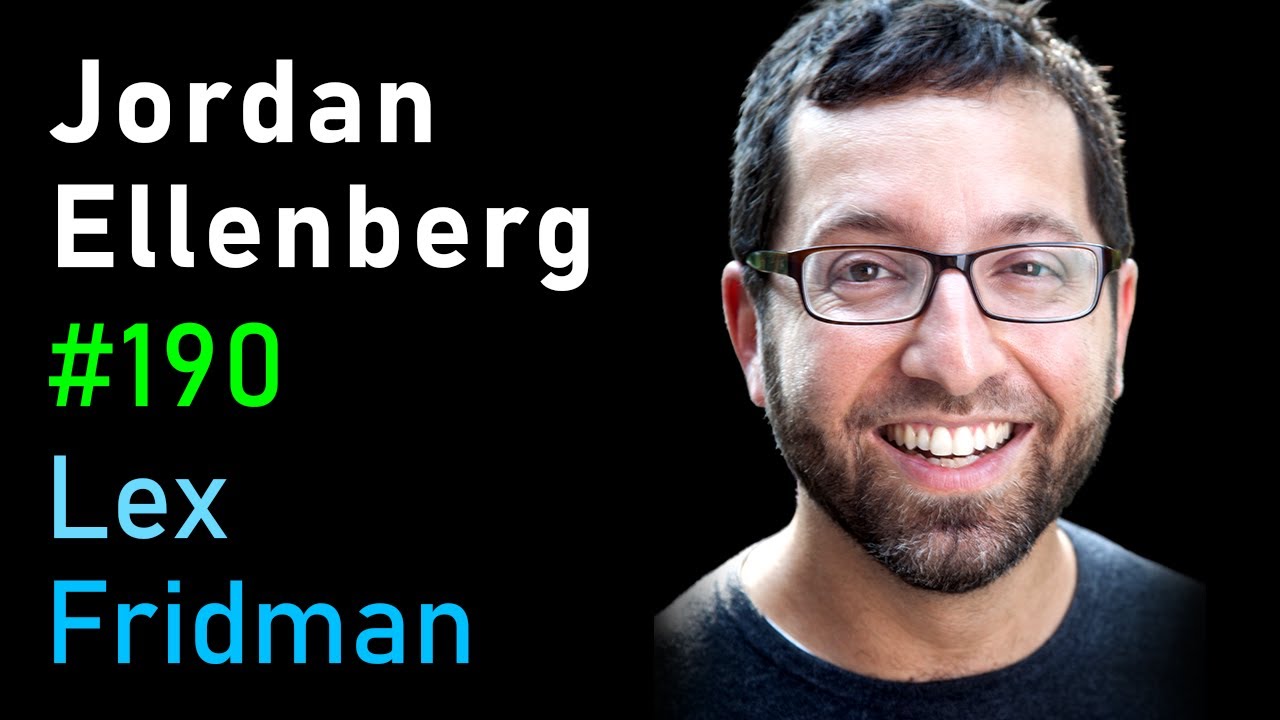
Key Insights
- Ellenberg argues that geometry polarizes opinions, likening it to 'cilantro of math' — loved by some, incomprehensible to others.
- Recognizing digits like '2' and '3' involves complex cognitive tasks beyond classical symmetry, challenging AI capabilities.
- Fermat's Last Theorem's proof by Andrew Wiles reveals deep connections in number theory, transforming the field.
- The two-adic metric redefines distance, offering new insights into mathematical structures and AI applications.
- Grigori Perelman's refusal of the Fields Medal highlights personal integrity over conventional accolades in mathematics.
How the conversation moved
The conversation begins with Ellenberg discussing the nature of mathematical thinking and its parallels to language, emphasizing the cognitive processes involved in both. He shares personal anecdotes, such as a childhood experience with a six by eight array of holes, to illustrate the development of his mathematical understanding. This sets the stage for a broader discussion on how geometry and visual proofs play a crucial role in mathematical education and perception, likening geometry to cilantro due to its polarizing nature.
Ellenberg moves on to explore the complexities of symmetry, particularly in the context of recognizing handwritten digits like '2' and '3'. He argues that current AI models struggle with these tasks because they involve more than classical symmetry transformations. This discussion leads into the historical context of mathematical development, highlighting Poincaré's contributions and the unresolved nature of the three-body problem, which underscores the enduring mysteries in mathematics.
Lex challenges Ellenberg on the notion that digit recognition could be simplified to classical symmetry, prompting Ellenberg to assert the complexity of cognitive processes involved. This pushback highlights the limitations of current AI capabilities and suggests the need for more advanced models. The conversation pivots to the proof of Fermat's Last Theorem by Andrew Wiles, illustrating how profound mathematical insights can transform entire fields and open new avenues for exploration.
The episode concludes with a discussion on redefining distance in mathematics through the two-adic metric, offering new insights into mathematical structures and AI applications. Ellenberg also touches on the philosophical implications of mathematical integrity, as exemplified by Grigori Perelman's refusal of the Fields Medal. This act challenges conventional views on the importance of awards in mathematics, emphasizing personal integrity and the pursuit of understanding over recognition.
Surprising moments
In-depth
Mathematical Thinking and Geometry
- Ellenberg describes geometry as polarizing, akin to cilantro in food preferences.
- Mathematical thinking is compared to language manipulation, involving similar cognitive processes.
Symmetry and AI Challenges
- Recognizing digits involves complex cognitive processes beyond classical symmetry.
- Current AI struggles with tasks like digit recognition due to these complexities.
Fermat's Last Theorem
- Andrew Wiles' proof of Fermat's Last Theorem transformed number theory.
- The theorem highlights the richness and complexity of mathematical problems.
Redefining Distance in Mathematics
- The two-adic metric offers a new way to understand distance in mathematics.
- This redefinition has implications for AI and understanding mathematical structures.
Mathematical Integrity and Awards
- Perelman's refusal of the Fields Medal emphasizes personal integrity.
- This act challenges conventional views on the importance of awards in mathematics.
Notable Quotes
I think the process of manipulating the visual elements is the same as the process of manipulating the elements of language.
Still open
- Lex questioned whether the universe's shape is flat, opening a debate on cosmological theories.
- Ellenberg pondered the implications of redefining distance in AI and mathematical structures.
References & Resources
- How Not To Be Wrong by Jordan Ellenberg — Search
- Shape, The Hidden Geometry of Information, Biology, Strategy, Democracy, and Everything Else by Jordan Ellenberg — Search
- On Proof and Progress in Mathematics by Bill Thurston — Search
- Flatland by Edwin Abbott — Search
- Winning Ways by Berlekamp, Guy, Conway — Search