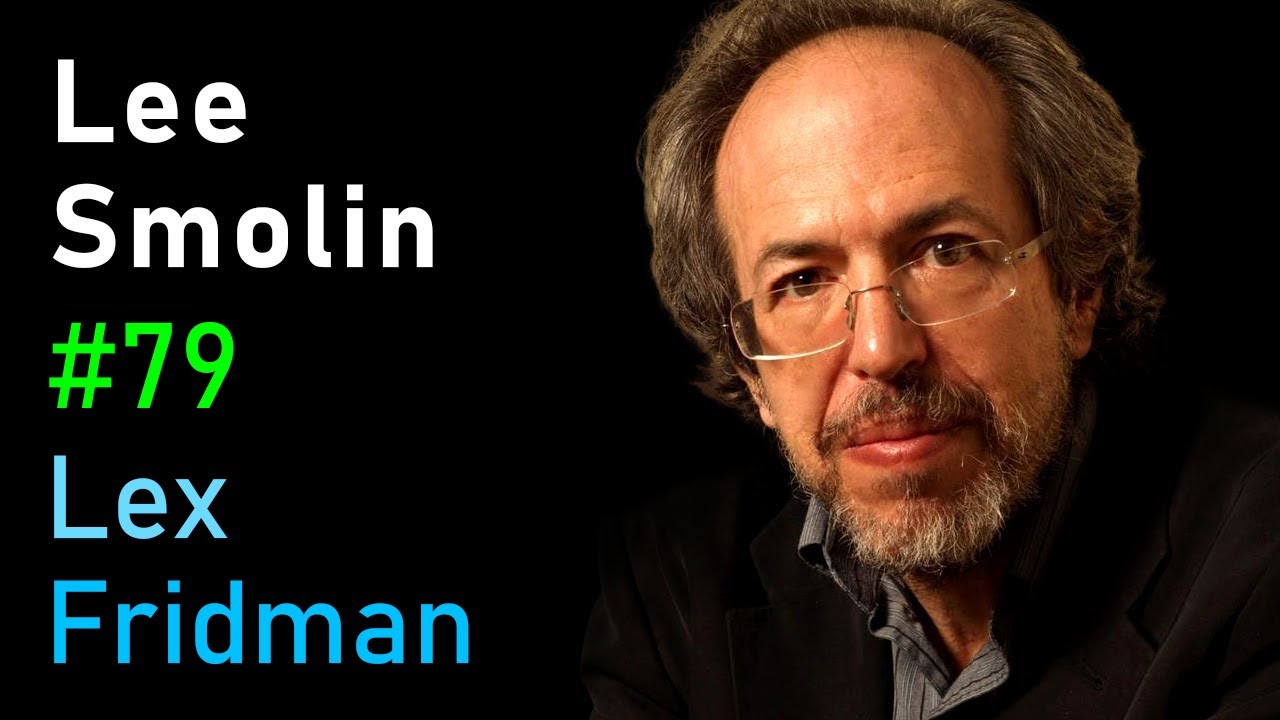
New Lex Fridman Insight: Lee Smolin: Quantum Gravity and Einstein's Unfinished Revolution
Sent June 11, 2026
Key Insights
- Lee Smolin argues that there is no single scientific method, challenging traditional views on scientific practice.
- Smolin's concept of cosmological natural selection suggests that the laws of physics could evolve similarly to biological evolution.
- Einstein's unfinished revolution involves unifying general relativity and quantum theory, which currently describe different scales of phenomena.
- Experiments have shown that Einstein's definition of locality is false, with significant deviations observed.
- The many worlds interpretation of quantum mechanics does not address the fundamental questions about probability and reality.
How the conversation moved
The episode begins with Lee Smolin challenging the traditional notion of a single scientific method, influenced by philosopher Paul Feyerabend. Smolin argues that science is not a monolithic practice but rather a collection of methodologies tailored to specific inquiries, emphasizing the ethical responsibility of scientists to report all findings. This sets the stage for a broader discussion on realism, where Smolin posits that reality exists independently of human perception, a stance that underpins much of his theoretical work.
Smolin introduces his concept of cosmological natural selection, suggesting that the laws of physics evolve similarly to biological evolution, potentially explaining the universe's fine-tuning. He contrasts this with the complexity of string theory, which, despite its mathematical elegance, offers a multitude of solutions that challenge its practical applicability. Smolin's involvement in developing loop quantum gravity is highlighted as an attempt to create a background-independent theory, offering an alternative to string theory's fixed spacetime framework.
Despite the compelling nature of Smolin's arguments, the conversation lacks significant pushback from the host, leaving some of Smolin's more controversial claims unchallenged. For instance, his dismissal of a single scientific method and the critique of string theory's phenomenological relevance could have been explored further. Additionally, Smolin's views on the many worlds interpretation of quantum mechanics, which he finds unsatisfactory, are presented without opposition, missing an opportunity for deeper debate.
The discussion concludes with a focus on Einstein's unfinished revolution, the need to unify general relativity with quantum theory, and the challenges posed by the measurement problem in quantum mechanics. Smolin emphasizes causality as a fundamental aspect of physics, proposing that space is an emergent property rather than a fundamental one. The episode closes with Smolin's critique of the many worlds interpretation, urging the scientific community to seek principles that better address the foundational questions of quantum mechanics.
Surprising moments
In-depth
Scientific Method and Realism
- Smolin argues against a single scientific method, influenced by Feyerabend.
- Realism posits an external world independent of perception.
- The scientific community operates under ethical precepts.
Cosmological Natural Selection and Quantum Gravity
- Cosmological natural selection suggests evolving physical laws.
- Loop quantum gravity aims for background independence.
- String theory's complexity raises phenomenological concerns.
Einstein's Theories and Quantum Mechanics
- Einstein's unfinished revolution involves unifying relativity and quantum theory.
- The measurement problem in quantum mechanics remains unresolved.
- Causality is proposed as a fundamental aspect of physics.
Locality and Interpretations of Quantum Mechanics
- Experiments show Einstein's locality is false.
- Quantum mechanics tested over long distances challenges locality.
- Many worlds interpretation fails to answer fundamental questions.
Notable Quotes
I don't believe there's a scientific method.
Still open
- Smolin questions whether the scientific community will find a unified theory that successfully merges general relativity and quantum mechanics.