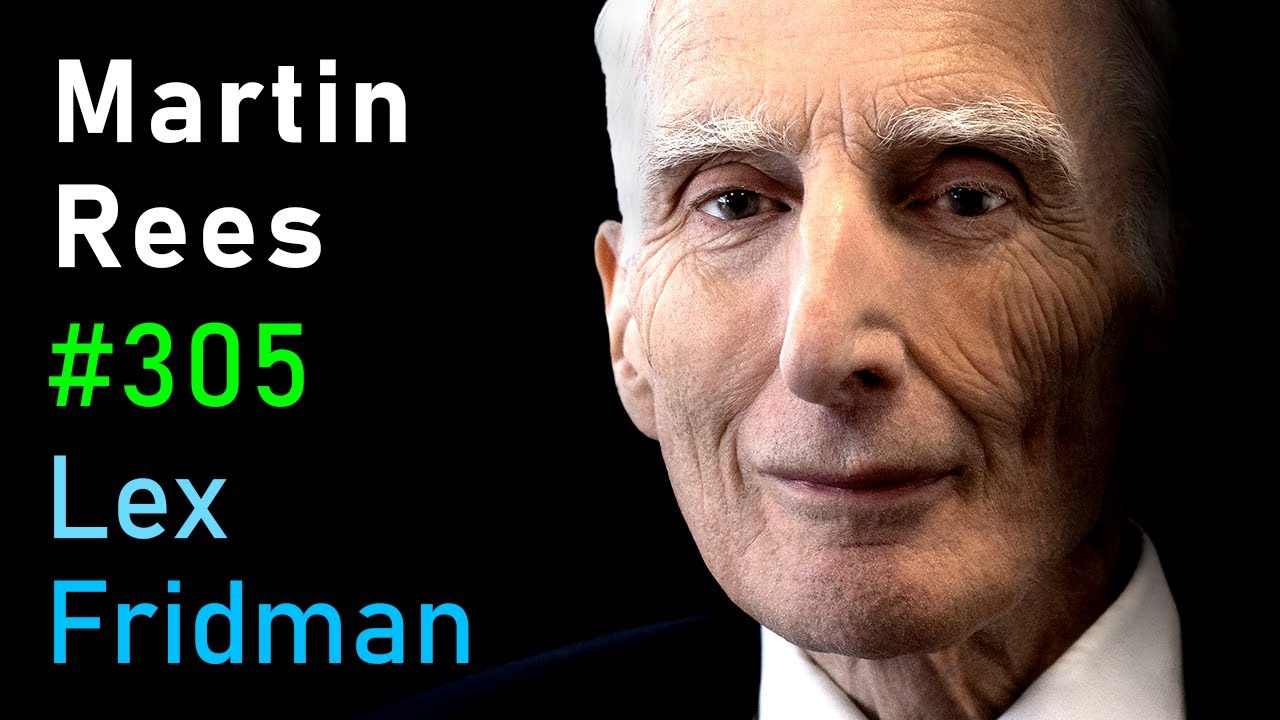
New Lex Fridman Insight: Martin Rees: Black Holes, Alien Life, Dark Matter, and the Big Bang
Sent June 11, 2026
Key Insights
- The universe may be 100 times larger than the observable boundary, suggesting vast unknowns beyond current detection limits.
- Dark matter is believed to be five times more prevalent than visible matter, inferred from gravitational effects on galaxies.
- Robots are increasingly seen as more efficient and cost-effective than humans for space exploration, challenging traditional views on human spaceflight.
- The concept of secular intelligent design suggests humans may evolve into electronic forms, adapting to new environments like Mars.
- AI could potentially solve complex physics problems, such as string theory, that are beyond human cognitive capabilities.
How the conversation moved
The conversation began with Martin Rees discussing the vastness of the universe, the complexity of life, and the potential role of AI in understanding these phenomena. Rees highlighted the enormity of the universe, suggesting it might extend 100 times beyond what we can currently observe. He also touched on the complexity of biological systems compared to physical ones, arguing that a 'theory of everything' might not necessarily help in understanding life. Rees suggested that AI could play a crucial role in solving complex problems in physics, such as string theory, which are currently beyond human cognitive capabilities.
Rees provided concrete evidence for his claims, noting that the universe's observable boundary might be just a fraction of its actual size, and that dark matter, inferred from gravitational effects, suggests a significant portion of the universe is unseen. He also discussed the advancements in space exploration, particularly the role of private companies like SpaceX, which have made rockets cheaper and faster due to reusable technology. Rees argued that robotic exploration is more efficient and cost-effective than human missions, challenging traditional views on the necessity of human spaceflight.
Lex Fridman pushed back on the idea that human spaceflight should be minimized, suggesting that the public is willing to fund risky endeavors for scientific exploration. He argued that companies like SpaceX and Blue Origin are doing some of the most inspiring engineering and scientific work ever done. Rees countered by emphasizing the impracticality and high costs of human spaceflight, suggesting it should be left to private ventures. He also introduced the concept of secular intelligent design, where humans might evolve into electronic forms to adapt to new environments like Mars.
The conversation concluded with Rees reflecting on the future of human evolution and the implications of discovering extraterrestrial life. He suggested that if life is found on moons like Europa or Enceladus, it would challenge the notion of humanity's uniqueness. Rees also expressed concerns about technological risks, such as nuclear threats and the need for better preparedness and resilience in society. The discussion ended with an acknowledgment of the speculative nature of cosmological theories and the potential for future discoveries.
Surprising moments
In-depth
Cosmology and the Universe
- The universe may extend 100 times beyond the observable boundary.
- Dark matter is inferred from gravitational effects, suggesting unseen mass.
- The observable universe was once compressed to the size of our solar system.
Space Exploration and Robotics
- Robots are more efficient for Mars exploration than humans.
- SpaceX's rockets are cheaper and faster than NASA's due to reusable tech.
- Human spaceflight is becoming less practical compared to robotic missions.
AI and Complex Problem Solving
- AI could solve complex physics problems like string theory.
- AI should not make decisions without human oversight in critical areas.
Notable Quotes
I think we're foolish to give any firm estimate because we just don't know.
Still open
- Rees questioned whether life is unique to Earth or common in the galaxy, acknowledging the lack of evidence either way.
- The potential for AI to solve complex physics problems like string theory remains an open question.
References & Resources
- Scientific American article 2020 by Martin Rees — Search
- If Science is to Save Us by Unnamed — Search
- The Future of Humanity by Martin Rees — Search
- On the Future: Prospects for Humanity by Martin Rees — Search
- The End of Astronauts by Martin Rees and Don Goldsmith — Search
- The Better Angels of Our Nature by Steven Pinker — Search
- Eternal Inflation by Andrei Linde — Search
- The Search for Extraterrestrial Intelligence by Yuri Milner — Search