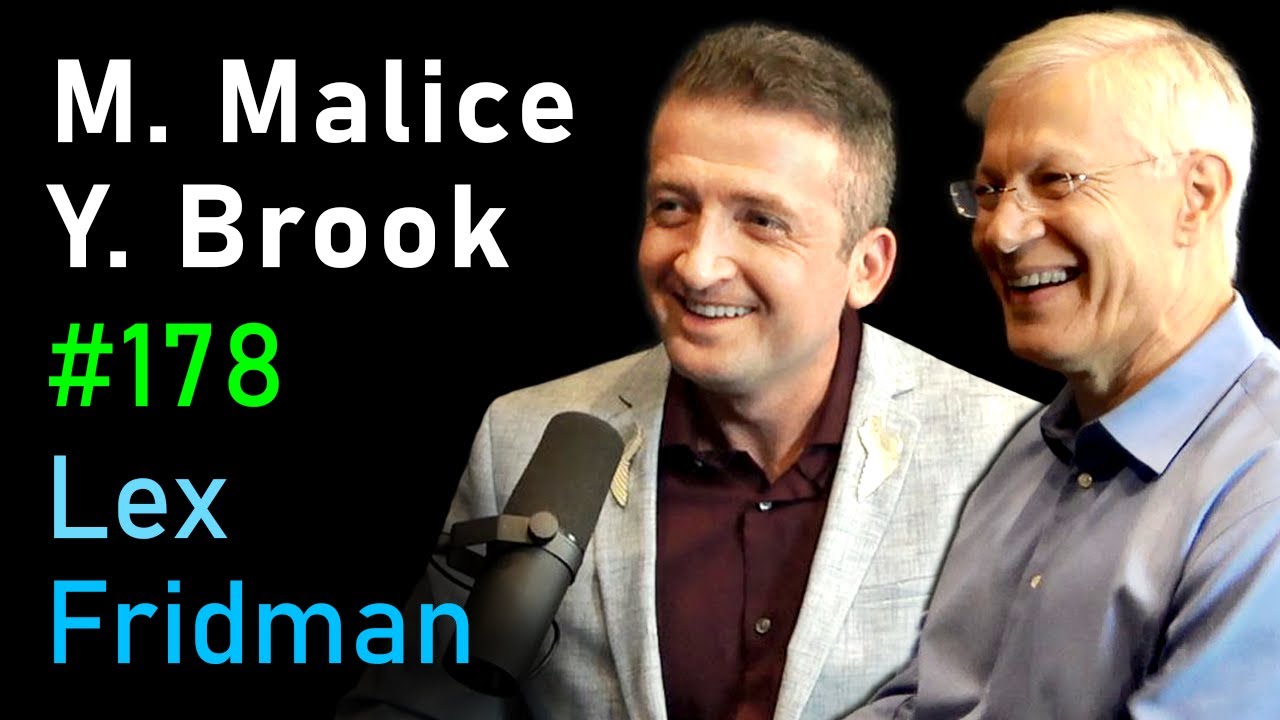
New Lex Fridman Insight: Michael Malice and Yaron Brook: Ayn Rand, Human Nature, and Anarchy
Sent June 11, 2026
Key Insights
- Michael Malice argues that anarchism can offer a viable alternative to state monopolies on violence by fostering accountability through competition.
- Yaron Brook critiques Donald Hoffman's views on evolution, asserting that reality is integral to evolutionary fitness, not detached from it.
- Brook claims that Ayn Rand's philosophy offers a coherent system of individualism and rationality, challenging collectivist ideologies like Marxism.
- Brook argues that humility is a vice rather than a virtue, as it undermines pride in one's achievements and contributions.
- Brook asserts that religion is a primitive form of philosophy that should be replaced by rational explanations of morality and reality.
How the conversation moved
The episode begins with the host framing the conversation around the central themes of Ayn Rand's philosophy, human nature, and anarchism. Michael Malice and Yaron Brook dive into the complexities of human cooperation and conflict, particularly in extreme situations. They discuss the role of individualism versus collectivism, with Malice arguing that cooperation is more prevalent than conflict, even in survival scenarios. Brook supports this by emphasizing that civilization is built on cooperation and rationality. This sets the stage for a deeper exploration of philosophical ideas, particularly those of Ayn Rand, and how they contrast with collectivist ideologies like Marxism.
Brook's main argument centers on the idea that Ayn Rand's philosophy offers a coherent system of individualism and rationality, which he believes is essential for human survival and progress. He critiques Donald Hoffman's views on evolution, asserting that reality is integral to evolutionary fitness. Brook argues that perceptions must align with reality, as emotions are conditioned responses to it. He also discusses the importance of reason, claiming that without it, humanity cannot survive. This perspective aligns with Rand's philosophy, which prioritizes reason and individualism over collectivist ideologies.
The conversation encounters tension when Brook challenges the conventional wisdom that humility is a virtue. He argues that humility undermines pride and is a vice rather than a virtue. This viewpoint is controversial, as humility is often seen as a moral good in many cultures. Additionally, Brook's critique of religion as a primitive form of philosophy that should be replaced by rational explanations of morality and reality adds another layer of contention. These arguments push against widely accepted norms and provoke thought on the role of philosophy and religion in modern society.
The discussion concludes with Brook and Malice exploring the implications of anarchism versus government systems. Malice argues that anarchism can offer a viable alternative to state monopolies on violence by fostering accountability through competition. Brook, however, remains skeptical, emphasizing the potential for violence and chaos in an anarchic system. The conversation leaves open questions about the feasibility of anarchism and the role of government in protecting individual rights. The episode ends with a reflection on the importance of living authentically and pursuing personal values over societal expectations, a theme that resonates with Rand's philosophy.
Surprising moments
In-depth
Anarchy and Government
- Anarchism proposes competition among private security firms to enhance accountability.
- Government monopolies on violence lead to inefficiencies and abuses.
- Anarchy is seen as a system that legalizes violence, requiring community-based solutions.
Reality and Evolution
- Brook argues that evolution is inherently tied to reality, not detached from it.
- He critiques the idea that perceptions are separate from reality, emphasizing their alignment.
- Emotions are responses to reality, conditioned by knowledge and values.
Ayn Rand's Philosophy
- Rand's philosophy challenges collectivist ideologies, promoting individualism and rationality.
- Her ideas are gaining traction among younger generations, despite misconceptions.
- Rand's definition of selfishness aims to reclaim the concept of self-esteem.
Humility and Pride
- Brook argues that humility undermines pride and is a vice, not a virtue.
- He believes pride in one's achievements is essential for personal and cultural contributions.
- This view challenges conventional wisdom on humility as a moral virtue.
Philosophy and Religion
- Brook claims religion is a primitive form of philosophy that should be replaced by rational explanations.
- He argues that philosophy can provide moral and existential guidance without religious frameworks.
- This perspective suggests a shift towards secular, rational approaches to understanding morality.
Notable Quotes
I don't have this negative view of human beings, particularly not as individuals. It's when they get into mobs and groups and collectives that ideology can really motivate them to do horrible things.
Still open
- What are the practical implications of anarchism in modern society, particularly regarding violence and accountability?
- How can Ayn Rand's philosophy be effectively communicated to younger generations who may be skeptical of its principles?
References & Resources
- The Free Market Revolution by Yaron Brook — Search
- Equal is Unfair by Yaron Brook — Search
- Dear Reader, The New Right by Michael Mallis — Search
- Anarchist Handbook by Michael Mallis — Search
- The White Pill by Michael Mallis — Search
- Atlas Shrugged by Ayn Rand — Search
- The Fountainhead by Ayn Rand — Search
- The Virtue of Selfishness by Ayn Rand — Search
- Red Famine: Stalin's War in Ukraine by Ann Applebaum — Search
- The Better Angels of Our Nature by Steven Pinker — Search