New Lex Fridman Insight: Russ Tedrake: Underactuated Robotics, Control, Dynamics and Touch
Sent June 11, 2026
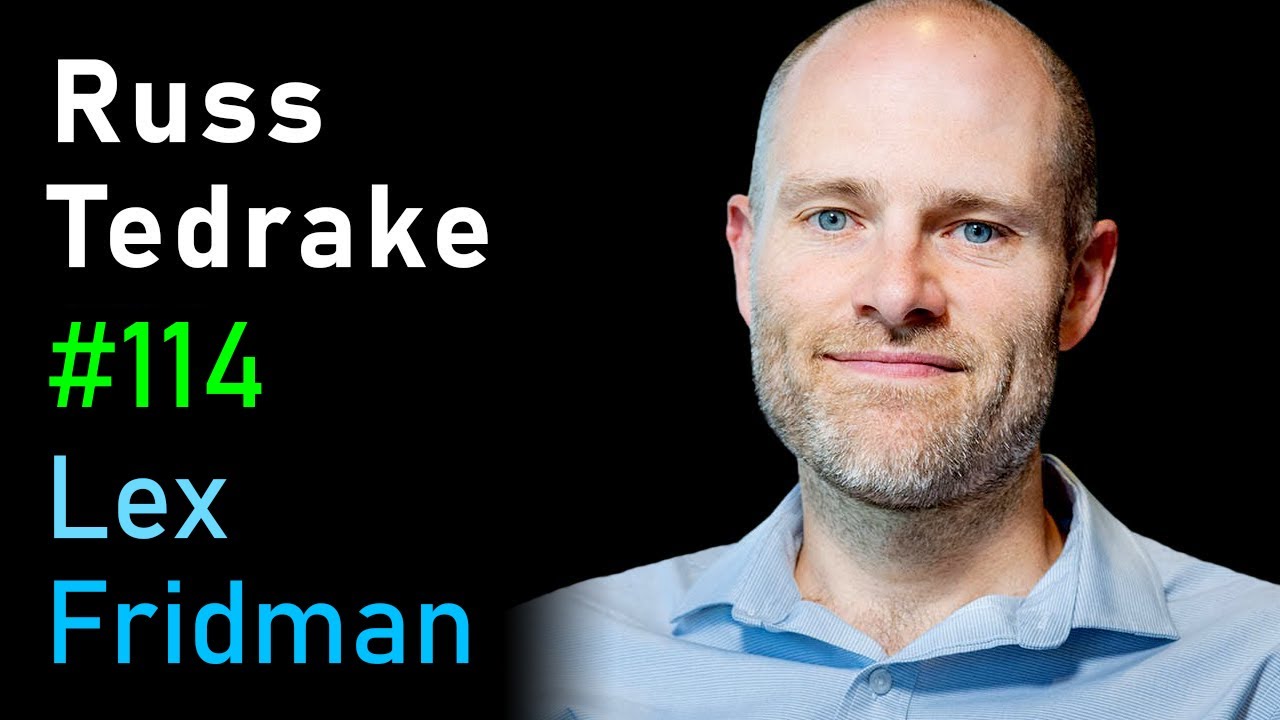
Key Insights
- Passive dynamic walkers, powered only by gravity, demonstrate more natural movement than complex robots like Honda's Asimo.
- Underactuated robotics, with fewer actuators than degrees of freedom, leverage physics for control, common in both robots and humans.
- Cultural perceptions of robots, influenced by media like 'Terminator' and 'Astro Boy,' shape public fear and acceptance.
- Drake simulator integrates multi-body dynamics and contact physics, crucial for realistic robotic manipulation.
- Soft robotics changes contact mechanics, enabling distributed loads and reducing risks of damage.
How the conversation moved
The conversation begins with Russ Tedrick highlighting the elegance of passive dynamic walkers, which achieve natural movement using gravity alone, in contrast to complex powered robots like Honda's Asimo. Tedrick emphasizes that these walkers, like those developed by Steve Collins and Andy Ruina, operate without controllers or batteries, showcasing a form of robotics that relies on the natural physics of motion. This sets the stage for a broader discussion on the efficiency of robotic systems that mimic natural movement, a theme that runs throughout the episode.
Tedrick's main argument centers around the concept of underactuated robotics, which involves systems with fewer actuators than degrees of freedom. This is a common trait in both human and robotic systems, requiring a reliance on physics to achieve control. He explains that optimization, particularly numerical optimal control, is crucial for managing the complexities of motion and manipulation in these systems. This approach is contrasted with more traditional robotics, which often rely on extensive control systems to manage every aspect of movement.
Lex Fridman does not explicitly challenge Tedrick's framing, although the discussion touches on potential tensions between traditional robotics approaches and the more physics-reliant methods Tedrick advocates. The absence of pushback leaves open questions about the scalability of underactuated systems in real-world applications. The conversation also explores cultural perceptions of robotics, noting how media influences public fear and acceptance, which indirectly shapes the development and deployment of robotic technologies.
The episode concludes with a focus on the Drake simulator, which integrates multi-body dynamics and contact physics to advance control systems in robotics. Tedrick describes Drake as not just a simulator but also an optimization library and a system modeling language, highlighting its role in facilitating complex robotics tasks. The discussion of soft robotics further illustrates how changing contact mechanics can improve the safety and functionality of robots, particularly in human-robot interactions. The conversation wraps up with reflections on the future of robotics and the potential for further integration into society.
Surprising moments
In-depth
Passive Dynamics in Robotics
- Passive dynamic walkers operate solely on gravity, showcasing efficient movement.
- Steve Collins and Andy Ruina's work at Cornell exemplifies this concept.
- Honda's Asimo, despite being advanced, lacks the energy efficiency of passive systems.
Underactuated Robotics
- Underactuated systems have fewer actuators than degrees of freedom.
- This concept is prevalent in both human and robotic systems, requiring physics-based control.
- Optimization techniques are crucial for managing these systems.
Cultural Influence on Robotics
- Media like 'Terminator' and 'Astro Boy' shape public perceptions of robots.
- These perceptions influence societal fear and acceptance of robotics.
- Understanding these influences is crucial for integrating robots into society.
Robotic Simulation and Control
- Drake simulator integrates multi-body dynamics and contact physics.
- This integration is essential for developing advanced control systems.
- Robust control techniques manage uncertainties in robotic tasks.
Soft Robotics and Contact
- Soft robotics changes contact mechanics, allowing for distributed load.
- This reduces the risk of damage to fragile objects during manipulation.
- Soft robotics enhances safety in human-robot interactions.
Notable Quotes
I think the most beautiful motion of a robot has to be the passive dynamic walkers.
Still open
- Lex asked about the scalability of underactuated systems in real-world applications, which remained unresolved.