New Lex Fridman Insight: Scott Aaronson: Computational Complexity and Consciousness
Sent June 11, 2026
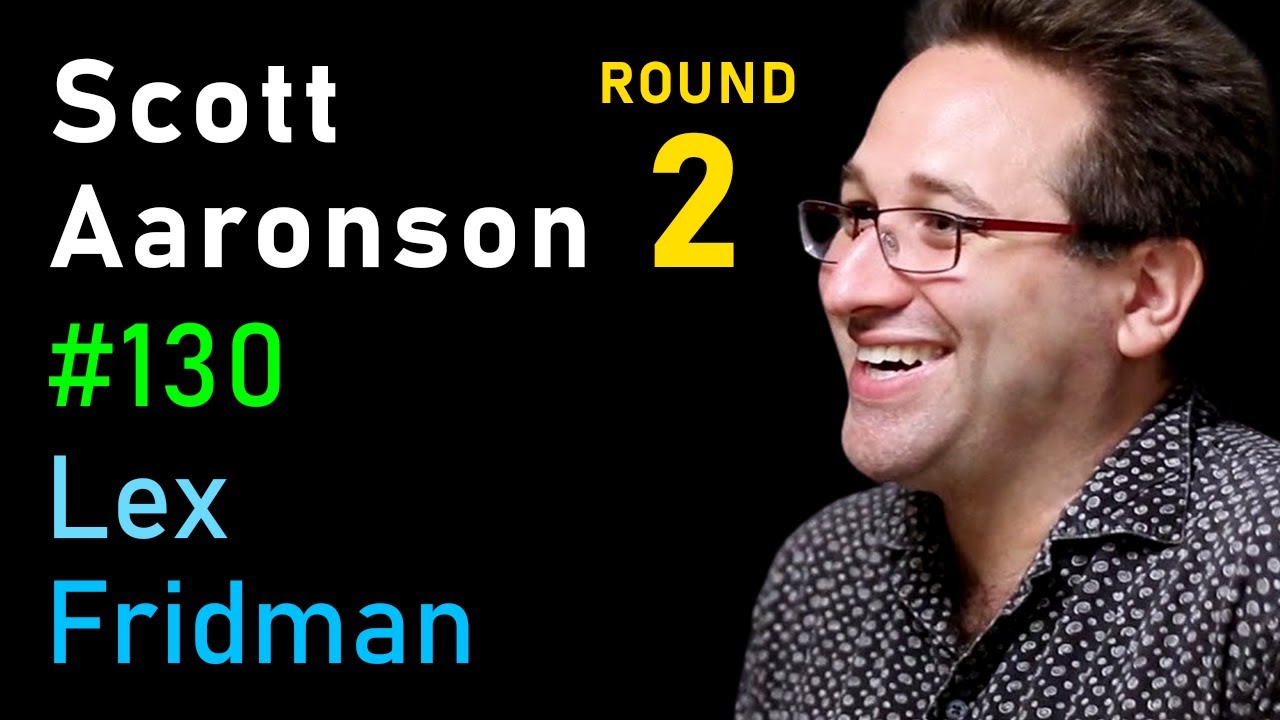
Key Insights
- Scott Aaronson critiques Integrated Information Theory, arguing that its claim about phi and consciousness is nonsensical.
- If P equals NP, it could break all current encryption methods, posing a massive security risk.
- Quantum computing's limitations suggest it cannot efficiently solve certain NP problems, like factoring large numbers.
- Roger Penrose's theory that consciousness involves quantum mechanics is not widely supported by physicists.
- The U.S. government's pandemic response is criticized as one of its greatest failures in history.
How the conversation moved
The conversation begins with Scott Aaronson discussing the implications of living in a simulation and the computability of the universe. He introduces the Church-Turing thesis, suggesting that the universe is computable and can be simulated by a Turing machine. Aaronson raises philosophical questions about the nature of reality and simulation, pondering how real a simulation needs to be to be immersive for humans. This sets the stage for a broader discussion on the intersection of computation and reality, touching on theories by Eric Weinstein and Stephen Wolfram, though noting they lack a complete theory of everything.
Aaronson then critiques Integrated Information Theory (IIT) as a model for consciousness, focusing on its use of the phi value to quantify consciousness. He argues that the claim that a system is more conscious with a larger phi value is nonsensical, highlighting the lack of formal derivation for phi and its reliance on postulates. This critique challenges the scientific validity of IIT, suggesting that its approach to measuring consciousness is fundamentally flawed. The conversation touches on the broader implications of computational universality and the limits of current models in explaining consciousness.
Lex Fridman and Aaronson delve into complexity theory, particularly the P vs NP problem and its implications for computer science and encryption. Aaronson explains that if P equals NP, it could break all current encryption methods, posing a massive security risk. The discussion also covers the limitations of quantum computing, noting that it cannot efficiently solve certain NP problems, like factoring large numbers. This challenges the hype around quantum computing, highlighting its current practical limitations and the importance of understanding complexity classes like BQP and P space.
The conversation concludes with a discussion on Roger Penrose's theory that consciousness involves quantum mechanics, which is not widely supported by physicists. Penrose's theory suggests that consciousness may involve unknown laws of quantum gravity, but most physicists believe that new phenomena in quantum gravity are not relevant to brain function. Aaronson critiques Penrose's reliance on Gödel's incompleteness theorem, noting that it is not widely accepted as a basis for claims about consciousness. The episode ends with a critique of the U.S. government's pandemic response, highlighting systemic issues in governance and the importance of open discourse.
Surprising moments
In-depth
Simulation and Computability
- The Church-Turing thesis implies the universe is computable.
- A perfect simulation would leave no direct evidence of a larger universe.
- Faster-than-light travel implies time travel due to relativity.
- Weinstein and Wolfram's ideas lack a complete theory of everything.
Critique of Integrated Information Theory
- IIT's phi value lacks formal derivation and is critiqued as nonsensical.
- Phi is defined by graph expansion and connectivity in systems.
- Aaronson argues a high phi value doesn't equate to more consciousness.
Complexity Theory and Quantum Computing
- P vs NP remains unsolved, with implications for encryption.
- Quantum computers struggle with large NP problems like factoring.
- BQP is a class solvable by quantum computers but contained in P space.
Penrose's Quantum Consciousness
- Penrose suggests consciousness involves quantum gravity and uncomputability.
- Most physicists disagree, seeing quantum gravity as irrelevant to brain function.
- Penrose's reliance on Gödel's theorem is not widely accepted.
Notable Quotes
If we are living in a simulation, it raises the question, how real does something have to be in simulation for it to be sufficiently immersive for us humans?
Still open
- Aaronson questions whether a theory of consciousness that suggests a blank wall could be more conscious than a human is valid.
- Lex Fridman asks if the potential of quantum computing is overestimated given its current limitations with NP problems.