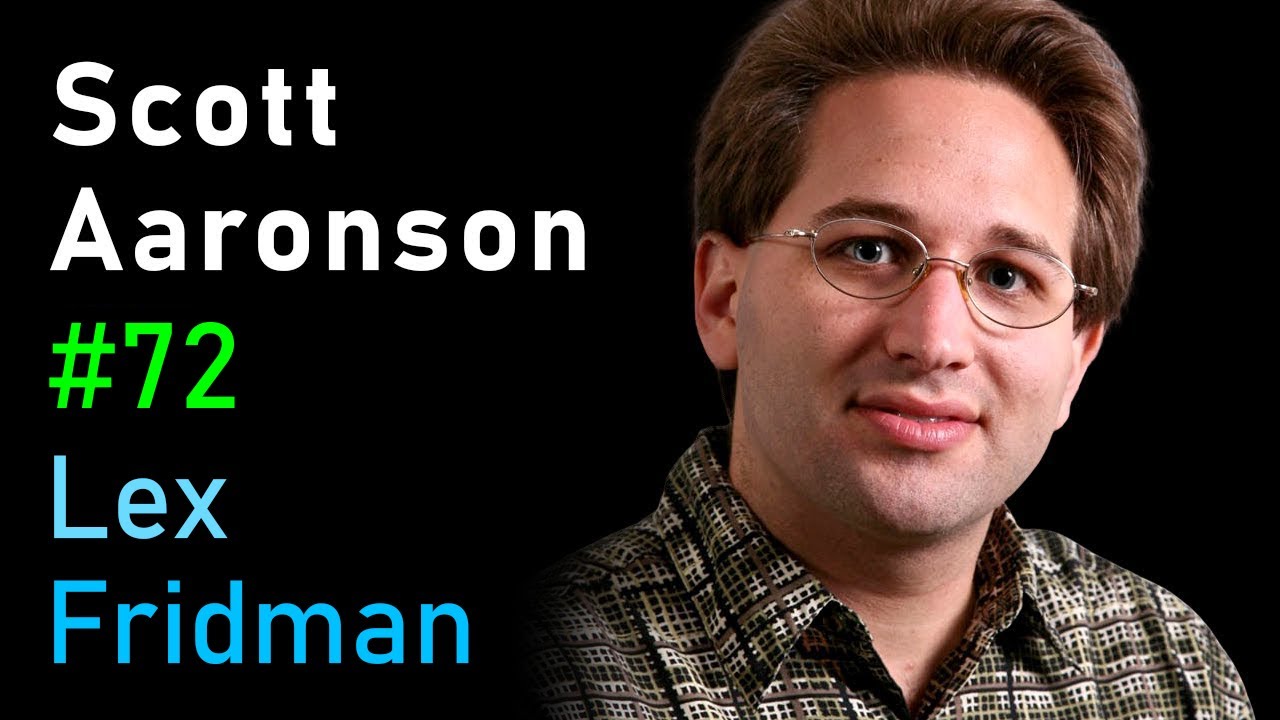
New Lex Fridman Insight: Scott Aaronson: Quantum Computing
Sent June 11, 2026
Key Insights
- Quantum supremacy was demonstrated by Google's quantum computer solving a sampling problem with 53 qubits, requiring classical verification of about nine quadrillion calculations.
- Quantum computing's potential to break current cryptographic systems hinges on scalable quantum computers, which require millions of qubits.
- Quantum error correction is essential for reliable quantum computing, as decoherence remains a significant hurdle.
- Quantum computing can solve NP-complete problems faster than classical computers, but the speedup is modest, not exponential.
- The current NISQ era allows quantum computers to perform tasks difficult for classical computers, despite being non-error corrected.
How the conversation moved
The conversation began with Scott Aaronson discussing the philosophical underpinnings of computer science, highlighting how philosophical questions have historically intersected with technical fields. Aaronson referenced Alan Turing's work and his debates with Wittgenstein to illustrate the importance of philosophical inquiry in shaping scientific progress. This set the stage for a broader discussion on how philosophical questions can reframe technical challenges, even if they don't provide direct solutions. Aaronson emphasized that while scientists often avoid metaphysical questions, they are crucial for understanding the broader implications of their work.
Aaronson then shifted to discussing quantum computing, particularly the concept of quantum supremacy, which was demonstrated by Google's quantum computer. He explained that Google's 53-qubit machine solved a sampling problem that would take classical computers an impractical amount of time to verify, marking a significant milestone in computing history. This achievement was framed as a demonstration of quantum computing's potential to outperform classical systems in specific tasks, although it remains far from the scalable quantum computers needed to impact cryptography.
The conversation touched on the implications of quantum computing for cryptography, where Aaronson noted that while scalable quantum computers could threaten current cryptographic systems, such machines require millions of qubits and are not yet feasible. He discussed the development of post-quantum cryptography as a proactive measure against potential threats. Benjamin pushed back against claims that quantum computing would imminently break all codes, arguing that such fears are premature given the current state of technology.
Finally, Aaronson addressed the limitations of quantum speedups, particularly in machine learning. He explained that while quantum computing offers speedups for certain problems, these are generally modest and not exponential. The discussion highlighted how dequantization has shown that classical algorithms can match some quantum algorithms, challenging the perceived uniqueness of quantum speedups. This led to a broader reflection on the current NISQ era, where quantum computers, despite their noise and lack of error correction, can still perform tasks that are challenging for classical computers.
Surprising moments
In-depth
Quantum Supremacy
- Google demonstrated quantum supremacy with a 53-qubit computer.
- Quantum supremacy requires solving tasks faster than classical computers.
- John Preskill coined the term 'quantum supremacy' in 2012.
Cryptographic Implications
- Scalable quantum computers could threaten current cryptographic systems.
- Post-quantum cryptography is being developed to counter potential threats.
- Millions of qubits are needed for practical cryptographic threats.
Quantum Error Correction
- Decoherence is a major challenge in quantum computing.
- Quantum error correction is essential for reliable quantum computing.
- The NISQ era involves non-error corrected quantum computers.
Quantum Speedups
- Quantum computing offers modest speedups for NP-complete problems.
- Quantum speedups are not exponential but still significant.
- Dequantization has shown classical algorithms can match some quantum algorithms.
Notable Quotes
Philosophy is just the thing that you have in the background from the very beginning that you want to, these are sort of the reasons why you went into intellectual life in the first place, at least the reasons why I did, right?
Still open
- Aaronson questioned whether the current improvements in qubit fidelity will suffice for practical quantum computing.
References & Resources
- Why Philosophers Should Care About Computational Complexity by Scott Aaronson — Search
- The Ghost in the Quantum Turing Machine by Unnamed — Search
- Shor's Algorithm by Peter Shor — Search
- Quantum Algorithms for Fixed Qubit Architectures by Karinidis and Prakash — Search
- Claude Shannon's paper by Claude Shannon — Search