New Lex Fridman Insight: Sean Carroll: Quantum Mechanics and the Many-Worlds Interpretation
Sent June 11, 2026
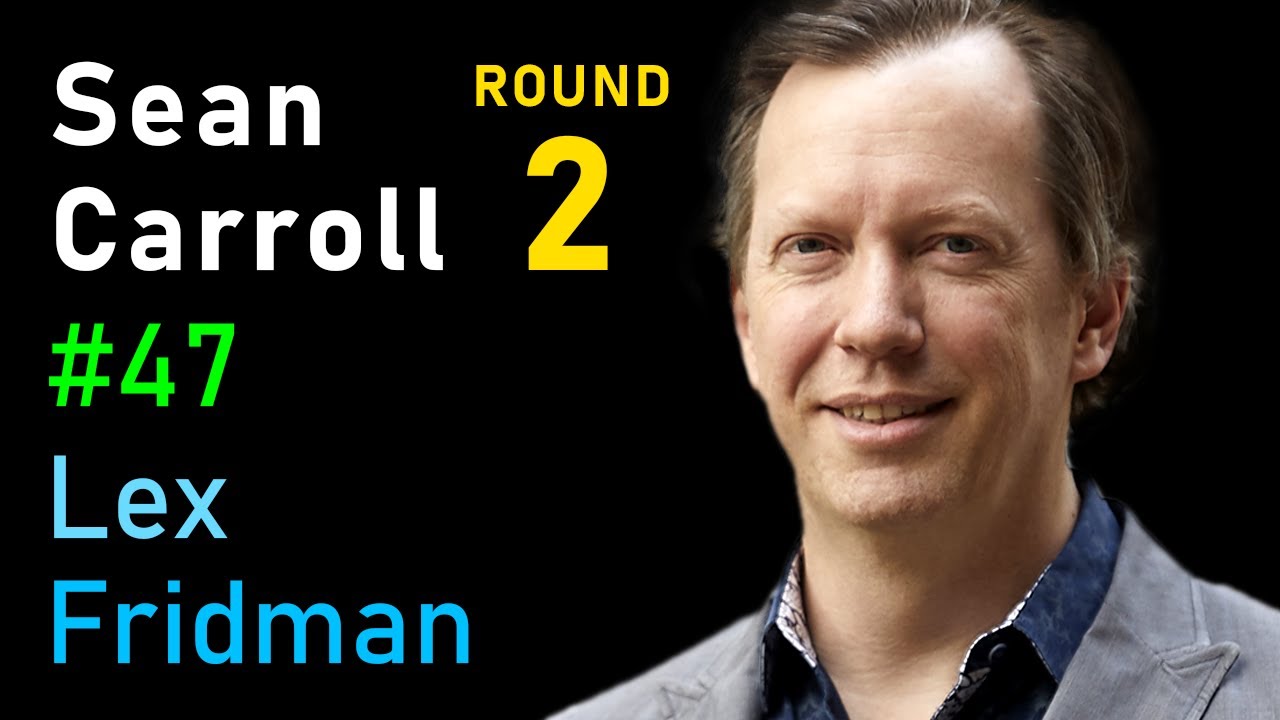
Key Insights
- Sean Carroll argues that the many worlds interpretation of quantum mechanics is simpler and more elegant than wave function collapse theories.
- Hilbert space, the mathematical space of quantum wave functions, is estimated to have a dimensionality of 10^10^122, vastly exceeding the number of particles in the universe.
- The many worlds interpretation suggests that new worlds are created whenever a quantum system in superposition entangles with the external world.
- Carroll emphasizes that the arrow of time is emergent and not embedded in the fundamental laws of physics.
How the conversation moved
The conversation begins with Sean Carroll setting the stage by discussing the historical evolution from classical mechanics to quantum mechanics. Carroll highlights how Newton's ideas of action at a distance were initially uncomfortable for him, leading to Laplace's field theory that removed the need for such concepts. This historical context sets the foundation for understanding how our intuitions about physics have evolved and can continue to evolve, allowing for a deeper comprehension of the universe.
Carroll then moves into discussing quantum mechanics, particularly the many worlds interpretation, which he argues is a simpler and more elegant solution compared to wave function collapse theories. He presents the vast dimensionality of Hilbert space as evidence supporting the many worlds framework, emphasizing that this interpretation does not violate conservation laws. Carroll's argument is bolstered by the mathematical simplicity and elegance that many worlds offers, which he believes aligns with the historical trend of scientific theories.
Despite the compelling case Carroll makes for the many worlds interpretation, the conversation lacks significant pushback from Lex Fridman. The absence of direct challenges leaves open questions about the practical implications and testability of the many worlds theory. While Carroll addresses potential criticisms regarding energy conservation, the broader philosophical and experimental challenges remain underexplored, suggesting a gap in the dialogue that could have been filled with more rigorous debate.
The discussion concludes with Carroll addressing the nature of time and space, suggesting that the arrow of time is an emergent property rather than a fundamental law. He acknowledges the limitations of current theories in explaining space-time, highlighting that while many worlds offers a promising framework, much work remains to be done. The conversation ends with an acknowledgment of the complexity and ongoing nature of these scientific inquiries, leaving room for future exploration and discovery.
Surprising moments
In-depth
Classical and Quantum Mechanics
- Classical mechanics evolved from Newton's ideas to field theories that eliminated action at a distance.
- Quantum mechanics introduces probabilistic elements and challenges classical intuitions about reality.
- The relationship between math and physics is both profound and philosophically complex.
Many Worlds Interpretation
- Many worlds interpretation posits that every quantum event creates new worlds.
- This interpretation avoids the complications of wave function collapse theories.
- Hilbert space's vast dimensionality supports the many worlds framework.
Emergent Time and Space
- The arrow of time is not a fundamental law but an emergent property linked to thermodynamics.
- Current theories of space-time are primitive and lack experimental predictions.
- Locality in physics is challenged by phenomena like black holes and holography.
Notable Quotes
I see no reason why the same thing isn't true for us today.
Still open
- Lex Fridman and Sean Carroll discuss the testability of the many worlds interpretation, leaving it open whether it can be empirically validated.
- Carroll mentions the emergent nature of space-time but acknowledges that current theories are not well-developed enough to make definitive predictions.