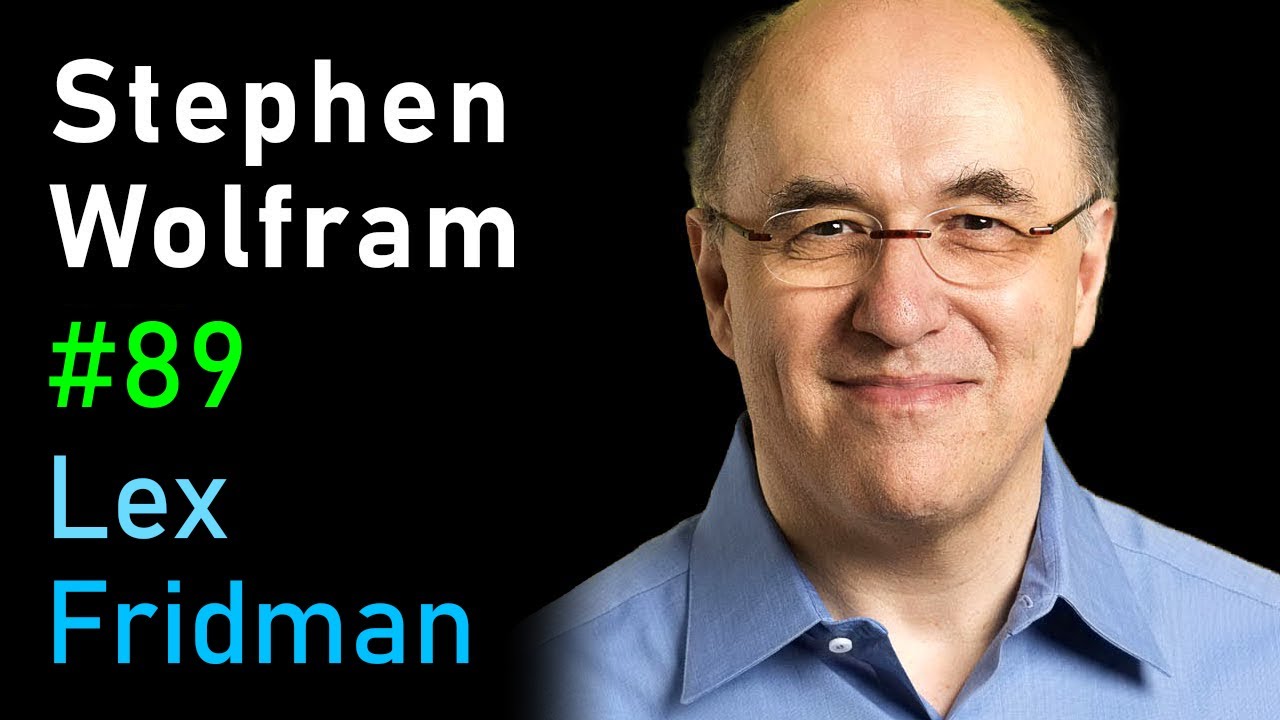
New Lex Fridman Insight: Stephen Wolfram: Cellular Automata, Computation, and Physics
Sent June 11, 2026
Key Insights
- Wolfram argues that AI represents a form of alien intelligence, challenging human-centric views of intelligence.
- The principle of computational irreducibility suggests that complex systems' outcomes can't be predicted without full simulation.
- Wolfram's Rule 30 cellular automaton demonstrates how simple rules can generate complex, seemingly random patterns.
- Wolfram Language aims to bridge human and machine understanding with 6,000 primitive functions.
- Wolfram posits that the universe's fundamental rules could be expressed in a single line of code.
How the conversation moved
The conversation begins with Wolfram discussing the nature of intelligence, particularly in the context of AI and extraterrestrial life. He posits that AI could be considered a form of alien intelligence, challenging the traditional human-centric view of intelligence. This framing leads to a discussion on how we communicate with AI and what this might imply for future interactions with extraterrestrial intelligences. Wolfram's perspective suggests that intelligence, whether human, artificial, or alien, might share fundamental computational processes.
Wolfram then delves into the nature of computation and its role in understanding the universe. He proposes that computation is a universal process that connects human intentions to the workings of the universe. This includes discussions on quantum mechanics and the potential for a fundamental theory of physics that could derive space, time, and matter from simple rules. Wolfram's argument is that the universe's complexity might emerge from these simple computational principles, challenging traditional scientific methods.
Despite the depth of these claims, there is a noticeable lack of pushback from Lex, which leaves some of Wolfram's more speculative assertions unchallenged. For instance, Wolfram's idea that the universe's fundamental rules could be expressed in a single line of code is a bold claim that could have benefited from further scrutiny. Lex's acceptance of Wolfram's ideas without challenge means that the conversation lacks the tension that might arise from a more critical examination of these concepts.
The discussion concludes with Wolfram's reflections on cellular automata, particularly Rule 30, and the development of Wolfram Language. These topics illustrate Wolfram's belief in the power of simple rules to generate complexity and his commitment to creating a computational language that bridges human and machine understanding. The conversation leaves open questions about the implications of these ideas for the future of science and technology, particularly in how they might reshape our understanding of the universe.
Surprising moments
In-depth
AI as Alien Intelligence
- AI represents a form of alien intelligence, challenging human-centric views.
- Communication with AI may parallel future communication with extraterrestrial life.
Computation and Physics
- Computation connects human intentions to the universe's workings.
- Causal invariance suggests time and space may be emergent properties.
Cellular Automata
- Rule 30 demonstrates complexity from simple rules.
- Cellular automata suggest nature's complexity arises from simple principles.
Wolfram Language
- Wolfram Language bridges human and machine understanding.
- The language includes 6,000 functions for broad applications.
Notable Quotes
I think the distinction for us is that there's kind of a thread of history and so on that connects kind of what happens in different brains to each other, so to speak.
Still open
- Wolfram wonders why our universe appears simple when many possible universes could be incredibly complex, suggesting a deeper mystery about reality.
- The conversation leaves open whether AI systems could embody different ideologies and how this might affect AI ethics.