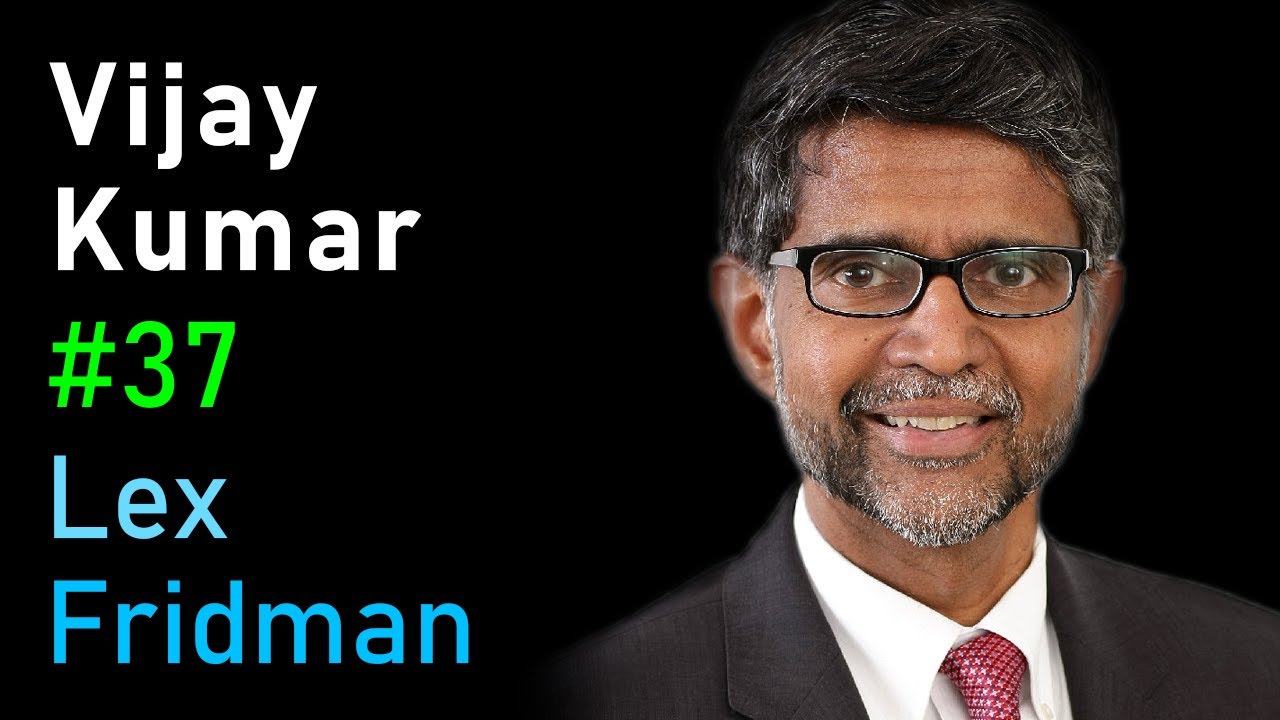
New Lex Fridman Insight: Vijay Kumar: Flying Robots
Sent June 11, 2026
Key Insights
- Vijay Kumar argues that 'drones' is a pejorative term, advocating for 'aerial robots' to reflect their complexity.
- Autonomous flying robots face challenges in GPS-independent navigation, requiring robust inertial measurement units (IMUs).
- Quadcopters' four-motor configuration is optimal for maneuverability, balancing simplicity and control.
- The economic and technological challenges of autonomous flight are deeply tied to battery technology and energy density.
- Kumar highlights the societal importance of technology literacy, especially for policymakers.
How the conversation moved
Lex Fridman opened the conversation by framing the central question around the evolution and future of flying robots, with Vijay Kumar providing a historical perspective on robotics. Kumar highlighted the development of multi-robot systems and drew inspiration from nature, noting the robustness and resilience seen in ant colonies. He emphasized the importance of terminology, arguing that 'drones' is a pejorative term that fails to capture the complexity of modern aerial robots. This set the stage for a deeper exploration of the technological and societal implications of robotic systems.
Kumar's main argument centered on the autonomy of flying robots, particularly the challenges of achieving true independence from external navigation aids like GPS. He detailed how inertial measurement units (IMUs) have become critical for reliable navigation, especially in urban environments where GPS signals are unreliable. Kumar also discussed the optimal design of quadcopters, noting their four-motor configuration as a balance between simplicity and control. He provided concrete examples of how these technologies have evolved, such as the advancements in UAV capabilities since 2007.
Lex did not challenge Kumar's framing on the terminology of drones versus aerial robots, though a potential counter-position could be the widespread acceptance and understanding of the term 'drones' in popular culture. However, Kumar did push back on the idea that machine learning has been a significant driver in the success of flying robots, suggesting that much of the control and planning has relied on other technologies. This moment highlighted a tension between the perceived role of AI and the actual technological underpinnings of autonomous flight.
The conversation concluded with a discussion on the broader societal implications of robotics, particularly the need for technology literacy among policymakers. Kumar stressed that as technology becomes a fundamental aspect of society, understanding its nuances is crucial for informed decision-making. The episode ended with an open question about the future integration of robotics in various sectors, leaving room for further exploration of the ethical and practical challenges posed by these advancements.
Surprising moments
In-depth
Terminology and Perception
- Kumar argues that 'drones' is a pejorative term, preferring 'aerial robots'.
- He believes the term 'robot' better captures the complexity and potential of these machines.
Autonomous Navigation
- True autonomy requires navigation without GPS or external infrastructure.
- IMUs are critical for reliable navigation, especially in urban environments.
Quadcopter Design
- Quadcopters' four-motor configuration offers optimal maneuverability.
- This design balances simplicity with control, crucial for complex environments.
Energy and Economics
- Battery technology and energy density are major constraints for autonomous flight.
- Economic viability of drones is tied to overcoming these energy challenges.
Technology Literacy
- Kumar stresses the importance of technology literacy for policymakers.
- Understanding technology is essential as it becomes a fundamental societal aspect.
Notable Quotes
I think beauty to an engineer is very different from beauty to someone who's looking at robots from the outside, if you will.
Still open
- Kumar questioned whether policymakers will adequately understand and integrate technology into decision-making processes.