New Lex Fridman Insight: Vladimir Vapnik: Statistical Learning
Sent June 11, 2026
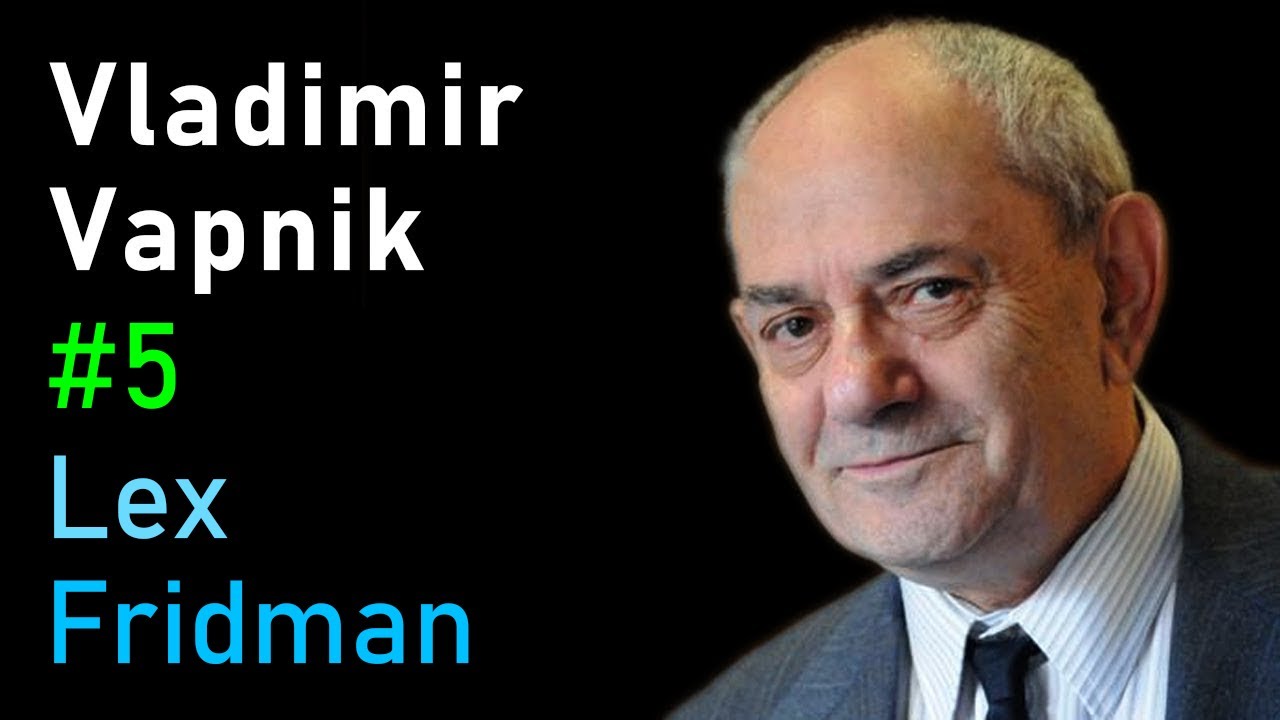
Key Insights
- Vladimir Vapnik argues that deep learning is a fantasy and lacks mathematical grounding, favoring shallow networks for optimal solutions.
- Vapnik highlights that every example in machine learning carries no more than one bit of information, challenging the efficiency of current data-heavy methods.
- The concept of VC dimension is crucial for understanding the capacity of a function set, impacting how effectively a model can learn with limited data.
- Vapnik suggests that incorporating invariants could drastically reduce the amount of data needed for tasks like digit recognition, potentially by a factor of 100.
How the conversation moved
The episode begins with Lex framing the discussion around the philosophical implications of machine learning, with Vladimir Vapnik introducing the concepts of instrumentalism and realism. Vapnik emphasizes the importance of understanding machine learning as a tool for grasping conditional probabilities rather than merely a means of classification. He introduces the concept of VC dimension, which relates to the capacity of a function set and is crucial for effective learning with fewer examples. This sets the stage for a deeper exploration of the mathematical underpinnings of machine learning, which Vapnik believes are often overlooked in current practices.
Vapnik's main argument is a critique of deep learning, which he describes as a 'fantasy' lacking in mathematical foundation. He argues that the optimal solutions for mathematical problems in learning are found in shallow networks rather than deep architectures. Vapnik supports his argument by pointing out that deep learning often requires excessive amounts of training data, which he suggests is not necessary for solving certain problems effectively. He emphasizes that mathematics does not recognize deep learning or neurons, but rather focuses on functions, highlighting a disconnect between current trends and mathematical theory.
Lex does not challenge Vapnik's critique of deep learning directly, though the guest's strong stance against the prevailing trend in AI could be contentious. The potential pushback could revolve around the success stories of deep learning in various applications, which Vapnik dismisses as not fundamentally contributing to understanding mathematical problems. This lack of direct challenge leaves the conversation open to interpretation, as Vapnik's views sharply contrast with the enthusiasm surrounding deep learning in the AI community.
The conversation concludes with Vapnik discussing the potential for invariants to drastically reduce the amount of data needed for machine learning tasks. He suggests that incorporating these invariants could allow for achieving high accuracy with significantly less data, as demonstrated by the NIST digit recognition problem. Vapnik's insights into statistical learning theory, which took years to gain acceptance, underscore the long-term impact of foundational work. The episode ends with an open question about the future of machine learning and the balance between data efficiency and model complexity.
Surprising moments
In-depth
Philosophical Foundations
- Vapnik's work has over 170,000 citations, highlighting its impact.
- Machine learning aims to understand conditional probabilities, not just classification rules.
- VC dimension is key to understanding function set capacity.
- Instrumentalism vs. realism in mathematical understanding.
Critique of Deep Learning
- Deep learning is criticized as a fantasy lacking mathematical grounding.
- Shallow networks are argued to be more optimal than deep architectures.
- Excessive training data in deep learning may be unnecessary.
- Mathematics does not recognize deep learning or neurons, only functions.
Statistical Learning and Data Efficiency
- Deep learning achieves 99.5% accuracy on NIST with 60,000 examples.
- Incorporating invariants could reduce data needs by 100 times.
- Every example carries no more than one bit of information.
- Statistical learning theory took 20 years to gain acceptance.
Notable Quotes
Some people say that math is language which use God.
Still open
- Lex did not directly challenge Vapnik's critique of deep learning, leaving open the question of its role and effectiveness in AI.
References & Resources
- The Second World War by Winston Churchill — Search