Why it matters
RLVR's efficiency in improving accuracy could make it a cornerstone of future AI training methodologies.
The AI ecosystem in China is rapidly advancing, with multiple open-weight models emerging in 2026.
▶ 2:00
Why it matters
China's AI advancements could challenge US dominance, prompting strategic shifts in AI policy and investment.
Detailed Insights
AI Competition
+
•
DeepSeek's R1 model set a new industry standard in 2025.
•
Chinese firms like Z.ai are challenging DeepSeek with open models.
•
US models outperform Chinese models in outputs, affecting market dynamics.
Model Performance and Usage
+
•
GPT-5.2's context score improved from 30% to 70%.
•
Open models are known for weights, not usability.
•
Claude Code offers an engaging interface for projects.
Reinforcement Learning and AI Training
+
•
RLVR can improve model accuracy significantly in 50 steps.
•
Scaling laws predict relationships between compute and accuracy.
•
RLHF scaling does not show linear performance improvements.
Chinese AI Ecosystem
+
•
China's AI advancements challenge US dominance.
•
Multiple Chinese open-weight models emerged in 2026.
•
Chinese models use larger Mixture of Experts architectures.
How the conversation moved
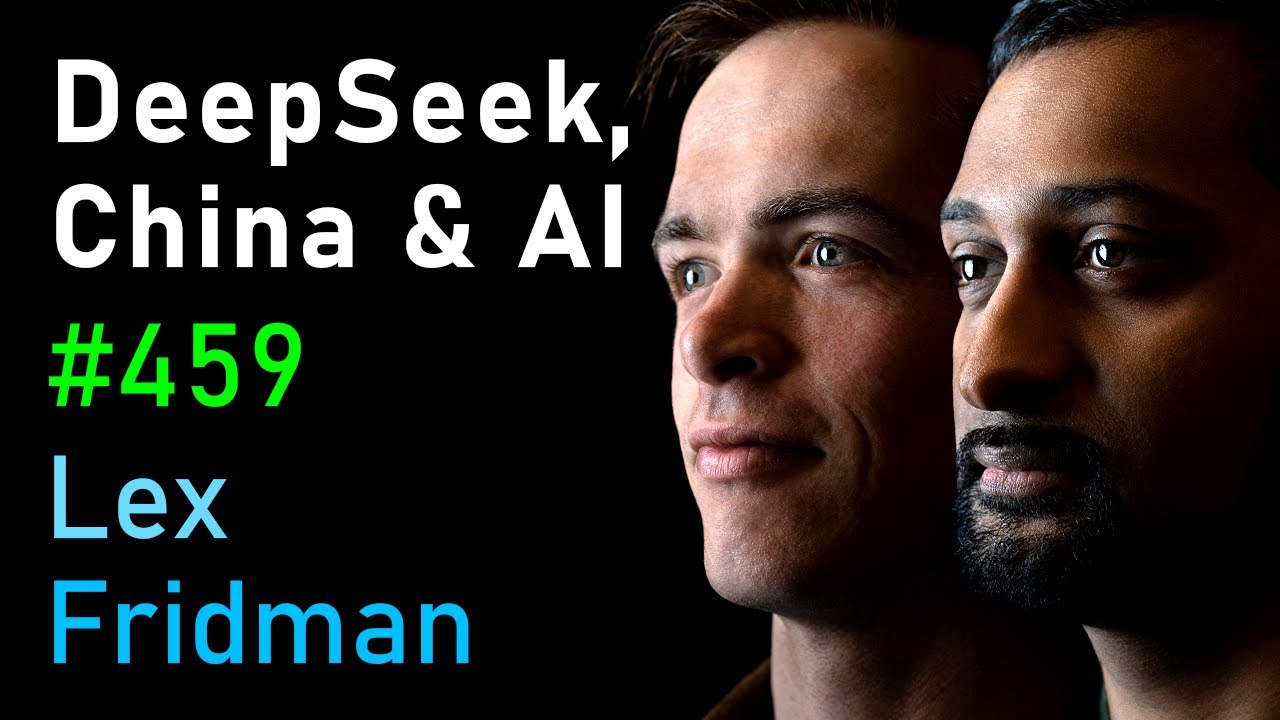
The episode begins with Lex Fridman framing the discussion around the current state and future trajectory of AI, focusing on the competitive landscape between US and Chinese AI firms. Sebastian Raschka and Nathan Lambert dive into the dynamics of AI models and companies, highlighting the impact of DeepSeek's R1 model, which set a new benchmark in 2025. They discuss the evolving dynamics between US and Chinese firms, noting that Chinese companies like Z.ai are gaining ground with competitive open-weight models, challenging DeepSeek's dominance.
Raschka argues that no single company will have exclusive access to technology due to frequent job changes among researchers. Lambert adds that the hype around Anthropic's Claude Opus 4.5 has overshadowed Google's Gemini 3, despite Gemini being a strong model. They explore the advancements in AI models, with GPT-5.2's context score improvement from 30% to 70% indicating significant algorithmic advancements. The conversation also touches on the role of open-weight models, with Chinese firms releasing models that are gaining popularity due to their unrestricted licenses.
Despite the comprehensive exploration of AI advancements, there is little pushback from Lex on the guests' claims. The conversation lacks explicit challenges to the optimistic view of AI's trajectory, such as the potential risks of open-weight models or the sustainability of current AI development practices. However, Raschka does question the notion that AI could replace the joy of debugging, arguing that the struggle is part of the learning process, which could be diminished by over-reliance on AI tools.
The discussion concludes with an examination of the broader implications of AI advancements, including the economic impact and the potential for AI to drive significant GDP growth over time. Lambert and Raschka emphasize the importance of open models in the US to compete with China's rapidly advancing AI ecosystem. They also touch on the historical impact of GPUs on deep learning and future technological advancements, suggesting that the future of technology may not solely be defined by AI but by the broader concept of computing and its evolution.
Surprising moments
Sebastian Raschka
Raschka argues that the joy of debugging is part of the learning process, which AI might diminish.
Nathan Lambert
Lambert disagrees with the AI 2027 report's timeline for achieving a superhuman coder, expressing skepticism.
Nathan Lambert
Lambert pushes back against the idea of a universal AI model, stating that specialized models are more realistic.
Topics Covered
AI CompetitionModel Performance and UsageReinforcement Learning and AI TrainingChinese AI Ecosystem
Memorable Quotes
"I don’t think nowadays, in 2026, that there will be any company having access to a technology that no other company has access to." — Sebastian Raschka
"DeepSeek is definitely winning the hearts of the people who work on open weight models because they share these as open models." — Sebastian Raschka
"Honestly, building an LLM from scratch is a lot of fun and a lot to learn." — Sebastian Raschka
"The idea of scaling laws came when people figured out that that was a very predictable relationship." — Nathan Lambert
"I think we’ll slowly push it out as AI solves more compelling tasks—like the likes of Claude Opus 4.5 making Claude Code just work for things." — Nathan Lambert
"The only fair way to evaluate an LLM is to have a new benchmark that is after the cutoff date when the model was deployed." — Sebastian Raschka
"I think the trick with the book is basically to understand how the LLM works." — Sebastian Raschka
"I think there will be some other big multi-billion dollar acquisitions, like Perplexity." — Nathan Lambert
"The US should be building the best models so that the best research happens in the US and those US companies take the value from being the home of where AI research is happening." — Nathan Lambert
Still open
Unresolved by the end of the conversation
Raschka questioned how future developers will learn if they rely too heavily on AI, suggesting it could hinder their development into experts.
Lambert expressed skepticism about the feasibility of fully automating programming in the near future.
Jargon glossary
open weight models
AI models whose parameters are publicly available for research and development.
Mixture of Experts (MoE)
A neural network architecture that uses multiple expert networks to improve performance.
Reinforcement Learning with Verifiable Rewards (RLVR)
A method where models learn from their outputs and improve accuracy through a generate-grade loop.
AI-generated summary
· last refreshed
2026-05-31 17:04:54
· how we make these
Quotes are matched verbatim against the source transcript; references are checked to resolve to real URLs. Even so, AI can misread structure or attribute claims imperfectly. If you spot an error, please let us know.
Report an inaccuracy →
Free weekly summary · one Lex Fridman episode, every Friday.