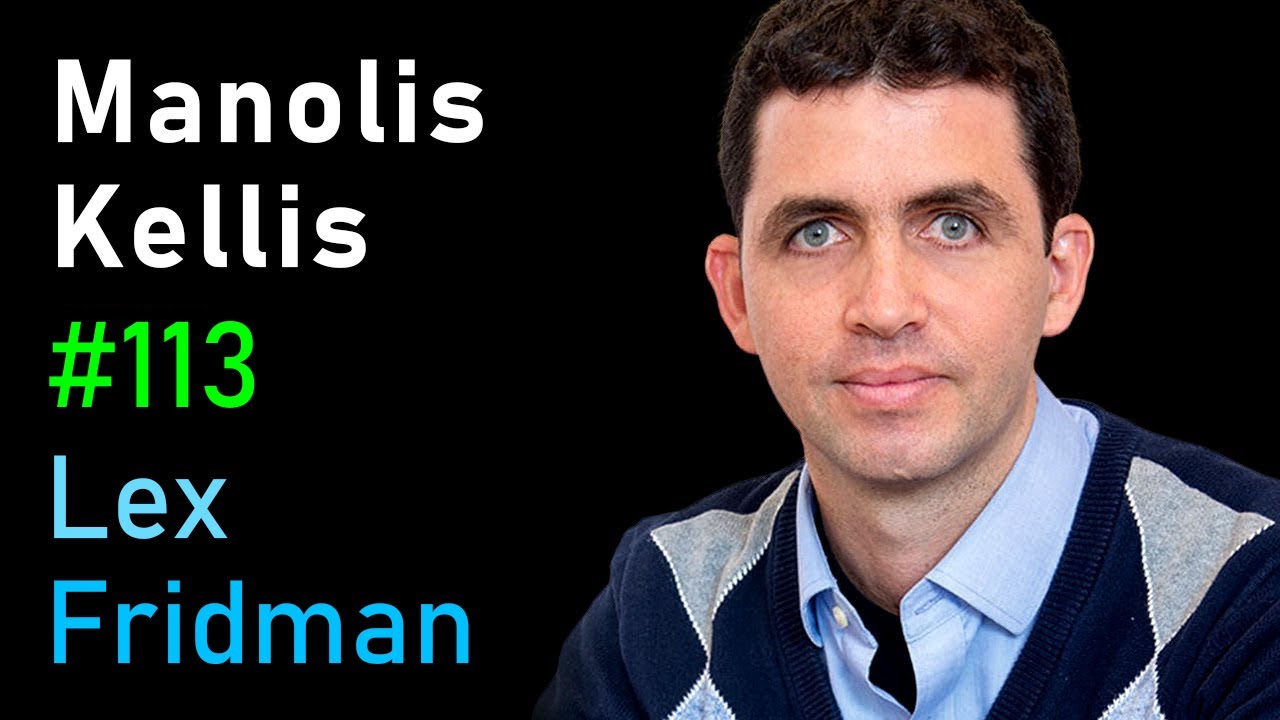
Manolis Kellis: Biology of Disease
Manolis Kellis argues that understanding human disease requires embracing the complexity of genetic variants beyond protein-coding genes. CRISPR technology revolutionizes genome ed...
Every Lex Fridman Podcast conversation, summarized. 483 episodes.
Manolis Kellis argues that understanding human disease requires embracing the complexity of genetic variants beyond protein-coding genes. CRISPR technology revolutionizes genome ed...
Comma AI's Comma 2 device, priced at $1,000, supports 91 car models and aims to reach 100 by year-end. George Hotz argues that Tesla's multitask learning approach to autonomous dri...
Swift's value semantics reduce the need for defensive copying, enhancing efficiency and mathematical consistency. MLIR outperforms LLVM by providing a flexible infrastructure for d...
Scott Aaronson critiques Integrated Information Theory, arguing that its claim about phi and consciousness is nonsensical. If P equals NP, it could break all current encryption met...
The human brain's size is typical for a primate, challenging the notion of its exceptionalism. Emotions are constructed from past experiences rather than being innate reflexes. The...
Michael Malice argues that anarchism, unlike democracy, doesn't require leaders, making it more adaptable and less corruptible. Mockery and trolling are seen by Malice as effective...
Joe Rogan emphasizes the fragility of societal civility, noting how easily it can be disrupted by events like the pandemic. Rogan argues that physical exertion is essential for men...
Java was created at Sun in 1990 to address computing trends outside traditional industries, like consumer electronics and networking. Over 50% of software security vulnerabilities ...
Ryan Hall emphasizes the importance of selecting the right coach in martial arts, impacting personal growth and happiness. Hall argues that societal rules are constructed to manage...
Wolfram's principle of computational equivalence suggests that complex phenomena arise from simple rules, challenging traditional scientific predictability. The Wolfram Physics Pro...
The human epigenome compacts two meters of DNA into a cell nucleus, enabling complex gene regulation. Denisovans, Neanderthals, and modern humans interbred, affecting modern geneti...
David Fravor's UFO encounter involved a Tic Tac-shaped object performing maneuvers defying known physics. The SR71 remains the fastest aircraft, reaching speeds over 2,500 mph, hig...
Eugenia Kuyda created Replika after losing a friend, aiming to combat loneliness through AI companionship. 30% of millennials in the US report constant loneliness, with significant...
Francois Chollet sees intelligence as the ability to generalize efficiently to new situations, beyond prior knowledge. The ARC test, developed by Chollet, benchmarks fluid intellig...
David Eagleman introduces 'liveware' as a concept for a brain that physically reconfigures itself with experience, emphasizing neuroplasticity. Human brain plasticity varies across...
Grant Sanderson emphasizes that interactive learning, such as using Manim, enhances retention compared to passive consumption. Neural networks, like GPT-3, operate on layered struc...
Sheldon Solomon argues that death anxiety is a primary driver of human behavior, shaping cultural and personal actions. Existential terror is managed through belief systems that pr...
Sara Seager predicts that within two decades, advanced telescopes will provide hints of extraterrestrial life. The star shade project aims to block starlight to detect faint exopla...
Dilip George criticizes the Blue Brain project for simulating brain structures without understanding their functions, limiting its effectiveness. The Recursive Cortical Network (RC...
Passive dynamic walkers, powered only by gravity, demonstrate more natural movement than complex robots like Honda's Asimo. Underactuated robotics, with fewer actuators than degree...
The human genome is 99.9% identical across individuals, emphasizing shared humanity despite diversity. SARS-CoV-2's genome was sequenced within a week of the first sample, accelera...
Nuclear fusion requires temperatures of tens of millions of degrees Celsius, making it far more challenging than fission. The tokamak design uses magnetic fields to confine plasma,...
Richard Karp received the Turing Award in 1985 for his foundational work on algorithms, including proving 21 problems to be NP complete. The P vs NP problem asks if every problem w...
Jitendra Malik argues that achieving 99% of a computer vision solution is exponentially harder than reaching 50%, due to complex edge cases. Malik believes current AI systems requi...